
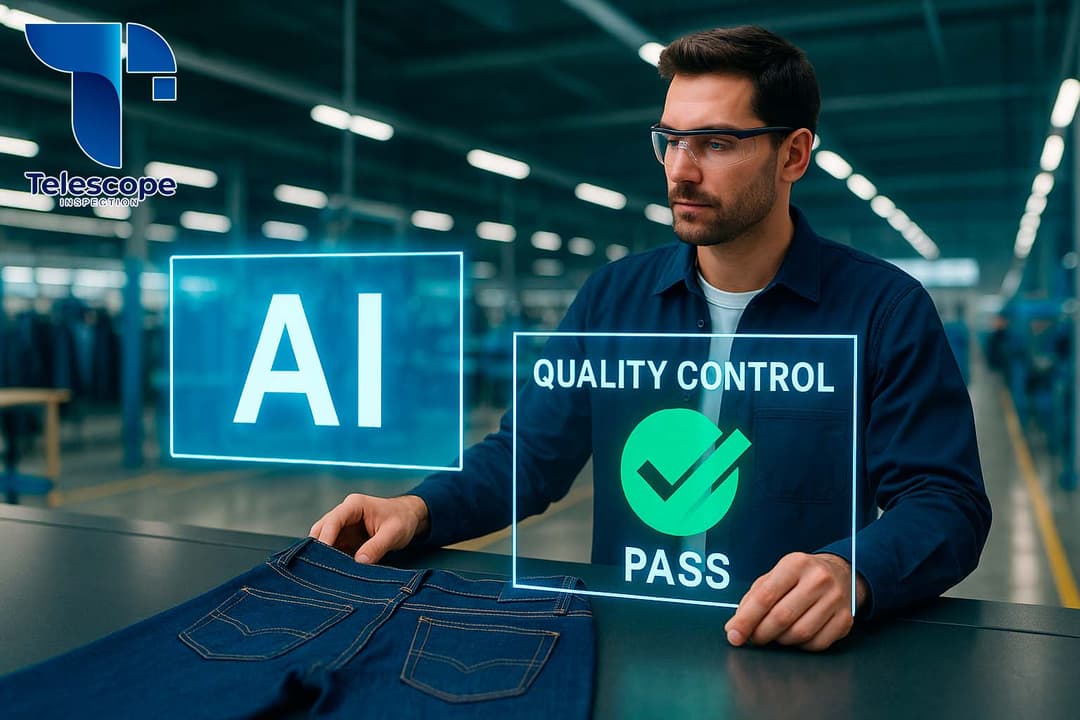
Imagine having an inspector who never gets tired, with superhuman vision and the ability to spot even the smallest defect. That is exactly what Artificial Intelligence (AI) is bringing to the inspection and quality control industry. In a sector where a tiny mistake can mean major losses or risks, AI has become the tireless digital “eye” that is profoundly changing the way companies guarantee the quality of their products.
This article explores how AI is driving a comprehensive transformation of this industry: detecting defects invisible to the human eye, reviewing labels with millimetre-level precision, identifying weaves and materials in textiles, speeding up processes, reducing supply chain risks and — very importantly — enhancing human work instead of replacing it.
Welcome to the new era of Quality 4.0, where artificial intelligence not only improves accuracy, but redefines what is possible in the world of quality control.
AI takes the stage in quality inspection
Traditional quality inspection relies heavily on human experience, but it is subject to fatigue, variability and even distractions. AI, on the other hand, does not blink, does not tire and can process thousands of images per minute with an astonishing level of accuracy. Its application in industry makes it possible to detect micro-defects, structural anomalies and erratic patterns that the human eye might overlook.
Detecting defects invisible to the human eye
Through computer vision algorithms and deep learning, AI can scan products for imperfections such as scratches, cracks, bubbles, colour variations or non-conforming shapes. These technologies are already applied in industries such as automotive, electronics and pharmaceuticals, where margins of error are practically zero.
Product image analysis: accuracy down to the millimetre
Smart cameras capture images of every product on the production line, and AI automatically compares them against ideal models. It can detect minimal design or assembly deviations with no need for human intervention. All of this happens in milliseconds, which keeps the production line moving without sacrificing quality.
Error-free labels: automatic review, no distractions
Labelling errors are among the most common and costly mistakes in many industries. AI can analyse printed text and verify spelling, alignment, barcodes, expiry dates and even consistency between ingredients and warnings. This kind of automated review not only prevents mass product recalls, it also protects brand reputation.
Fabrics and materials: in-depth analysis in the textile industry
AI is also being trained to analyse fabrics and materials, detecting texture differences, faulty weaves or blended fibres. Instead of relying on human touch or eyesight, hyperspectral cameras and artificial intelligence are used to verify textile composition, ensuring material consistency, quality and authenticity.
24/7 efficiency: no breaks, no repetitive errors
AI can work non-stop, performing just as effectively in the first minute as after 12 hours. Its ability to maintain constant standards and process data at high speed allows factories to operate with greater productivity, less downtime and a smaller margin of error.
Fewer risks, safer supply chains
By detecting errors at origin, AI reduces risks along the entire supply chain. Catching an error at the factory prevents a logistics, commercial or even safety problem at destination. In addition, AI-based systems are usually integrated with databases that enable traceability, predictive analysis and corrective actions before a large-scale failure occurs.
AI + human experience = augmented quality control
AI is not here to replace the inspector, but to empower them. Rather than removing the human from the process, it frees them from repetitive tasks so they can focus on higher-value decisions: interpretation, analysis and continuous improvement. This human-machine combination delivers smarter, more flexible and more reliable quality control.
What lies ahead: the future of intelligent inspection
In the coming years we will see:
- Predictive systems that detect potential failures before they occur.
- Full integration with production lines for real-time self-correction.
- More affordable equipment for small and medium-sized enterprises.
- Greater regulatory pressure to implement intelligent inspections.
The transformation is already under way, and those who adopt these tools in time will not only be reducing errors, but also setting themselves apart in a market where quality is increasingly decisive.
Impartial decisions: AI cannot be influenced
One of the most powerful — and least discussed — benefits of Artificial Intelligence in quality control is its ability to guarantee objective, impartial decisions. In the traditional model, where inspections depend exclusively on human judgement, there may be risks associated with outside influence or undue pressure from parties interested in altering the results of an inspection.
Although it is not a widespread practice, it is known in the industry that in certain manufacturing environments there may be attempts to sway inspectors through incentives, gifts or favours, with the aim of altering their technical assessment criteria. This represents a risk to the integrity of the process and to the buyer’s reputation.
This is where AI makes a radical difference: automated inspection algorithms are not affected by personal interests or external pressure. The decision to approve or reject a batch is based on measurable data, previously defined criteria and 100% quantitative analysis. AI has no emotions, builds no personal relationships and cannot be influenced.
These systems also leave a clear, verifiable digital trail: every image, every defect identified and every decision is recorded. This provides a level of traceability and transparency that strengthens confidence in the process, both for the client and for their own auditors or business partners.
In short: Artificial Intelligence represents an advance that is not only technological, but also ethical, for the quality control industry. It brings a level of integrity that strengthens the entire supply chain ecosystem.
Artificial Intelligence is transforming the quality control industry. Not as a passing trend, but as a powerful tool that improves accuracy, speeds up processes, reduces errors and protects brand reputation.
For companies pursuing excellence, this technology is not optional: it is the new standard.
At Telescope Inspection, we have been pioneers in the technological transformation of the inspection industry, from the development of our Previo en Origen (Container Loading Inspection) service to the digitalisation of the First Mile with advanced tools. Our vision has always centred on transparency, efficiency and trust. Today, we are ready to take the next step: integrating Artificial Intelligence into our processes to deliver faster, more accurate and more reliable services. Services that give our clients greater certainty and peace of mind in every decision they make.
The question is not whether you should adopt AI, but when. And if the answer is “now”, you can count on us to guide you through that evolution.