
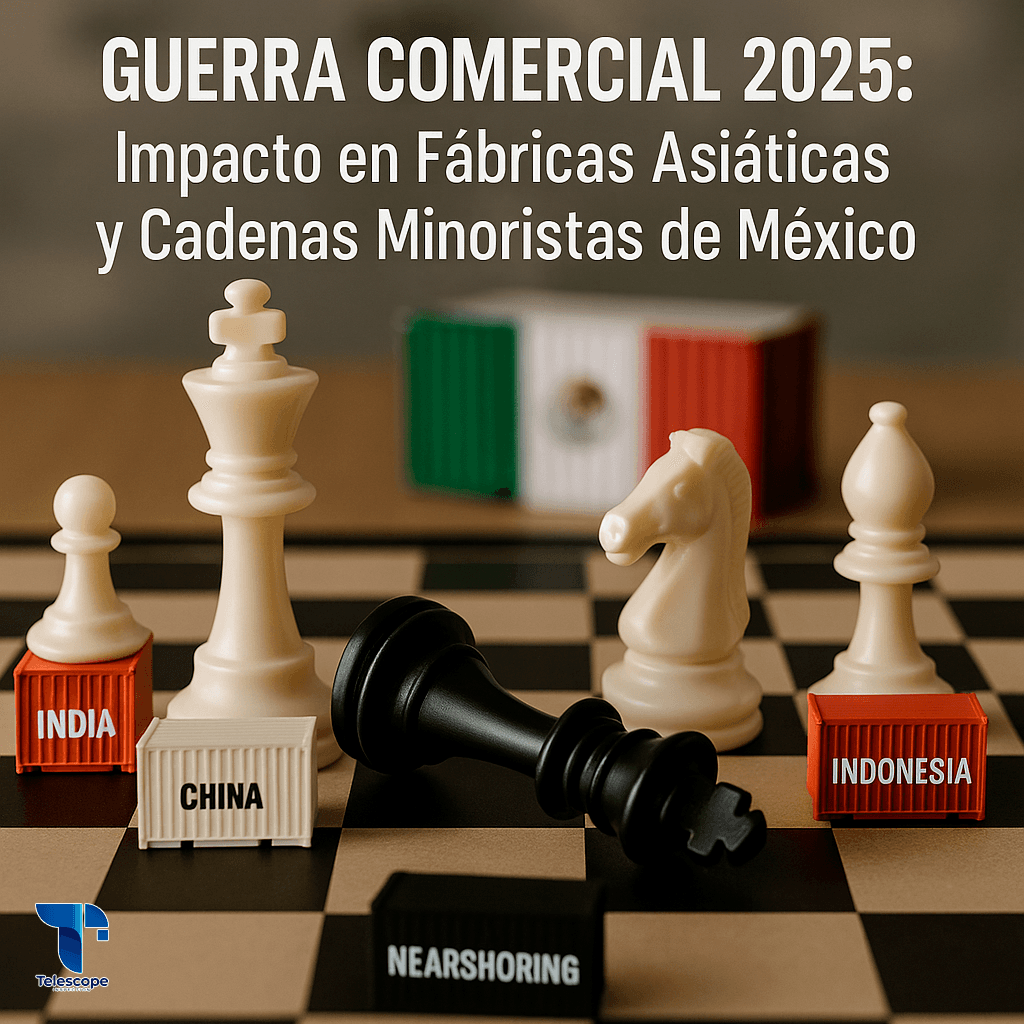
The escalation of the trade war between the United States and China in 2025 has triggered seismic effects across the global supply chain. What began as an exchange of punitive tariffs has quickly translated into idled factories, workers sent home and a climate of uncertainty that goes far beyond national borders. China's main exporting provinces – Guangdong, Jiangsu, Zhejiang, Fujian and Shandong – were the first to feel the blow, with temporary factory shutdowns, falling exports and production suspensions during April and May 2025. This production imbalance, caused by trade tensions, does not only affect the suppliers of the large US retail chains: its shock waves reach all the way to the large retail chains in Mexico, creating unprecedented challenges in supply, costs and traceability.
A direct hit to China's export factories
In the manufacturing hubs along China's coast, the situation has become critical. The abrupt drop in orders from North America has forced thousands of factories to halt operations and send their line workers home. Entire sectors – from textiles and apparel to toys, home appliances and plastic goods – are recording massive order cancellations. Extreme tariffs of up to 145% imposed by the US on Chinese products during April have frozen US demand. As a result, numerous plants in Guangdong and Zhejiang, used to producing non-stop for North American customers, have switched off their machines for lack of new orders.
Trade indicators reflect this contraction: in April 2025 alone, Chinese exports to the US plunged by more than 20% year on year. Although China's total exports still managed modest growth by redirecting shipments to other markets, the loss of US volume left a gap that is hard to fill. Around 15% of China's exports in 2024 were destined for the United States, a share that is now seriously at risk. Flagship companies in the major industrial corridors began reporting inventory piling up in warehouses, reduced shifts and hiring freezes. In traditionally bustling hubs such as Shenzhen and Ningbo, the contrast is obvious: idle production lines and unusually empty loading yards.
The situation in key coastal provinces such as Guangdong and Fujian illustrates the scale of the problem. In those regions, cuts to overtime and the suspension of weekend shifts have become commonplace, and quite a few companies have put their entire workforce on mandatory "vacation". In the manufacturing city of Dongguan (Guangdong), for example, an electrical goods manufacturer sent its employees home for a month on base pay after US buyers suddenly cancelled their orders. Likewise, a components plant in Hangzhou (Zhejiang) went as far as suggesting that its workers look for other jobs, given the prevailing uncertainty about whether production would continue. These drastic measures, unthinkable during the years of the export boom, point to an immediate future full of doubts for thousands of Chinese workers.
Local governments and industry associations in China have also sounded the alarm. Exporting cities such as Shenzhen have tried to contain the impact by offering subsidies for companies to take part in international trade fairs and by expanding export credit insurance. Such palliative measures, however, have only limited effect against the scale of the challenge. The trade war has moved from the negotiating table to the factory floor: what was once a matter of tariff schedules now shows up as empty plants and silent assembly lines, with significant human and economic consequences. Behind the statistics, it is thousands of workers who bear the uncertainty, fearing that temporary closures will become permanent. Labour analysts in China expect industrial restructuring to be a drawn-out process and, unfortunately, for workers to pay the highest price in this trade confrontation.
Production on the move: from the Chinese coast to new destinations
Faced with this landscape, many companies have begun to explore relocating their operations to ride out the crisis. Two escape routes stand out on the manufacturing horizon: moving inland within China or moving to other emerging Asian countries. Each option carries its own advantages and difficulties, but both point to a structural shift already under way.
On the one hand, several factories are choosing to move from the coastal provinces to China's inland or north-eastern provinces, seeking lower costs and access to available labour. Traditionally less industrialised regions such as Henan, Anhui, Hebei, Jiangxi and Sichuan have started attracting new plants with government incentives and the promise of lower wages. This inland relocation enjoys the explicit backing of the Chinese authorities, who see it as a way of keeping production inside the country. In fact, wages in inland provinces can be up to 30% lower than in competing Asian countries, which restores a degree of cost competitiveness to China without leaving its borders. The logic is simple: if workers no longer flock to the coastal factories, then the factories will "go" to the workers further inland. Major manufacturers have already taken this route. Foxconn, the electronics assembly giant, moved part of its production from Shenzhen to Chengdu (Sichuan) a few years ago and opened a colossal plant in Henan, taking advantage of these lower-cost regions to employ hundreds of thousands of workers. Now, under tariff pressure, more companies can be expected to follow this domestic strategy to bring costs down and reduce their exposure to the swings of international trade.
In parallel, another group of Chinese manufacturers is seeking shelter outside China, in Asian countries with low-cost labour and open markets. Vietnam, India, Bangladesh, Cambodia and Indonesia stand out as the preferred destinations for this offshore shift of production. The trend of moving manufacturing lines to these countries is not entirely new – it first accelerated during the 2018–2019 trade war – but in 2025 it has become almost unavoidable for certain industries. Apparel and footwear companies, for instance, had already shifted a significant share of their sourcing from China to South-East Asia in recent years. The idea was to spread risk and dodge the worst of the tariffs by diversifying suppliers. Now, with North American tariffs hitting almost anything "Made in China", these companies are stepping up their plans to produce in Vietnam or Cambodia, wherever their supply chains allow it.
The potential benefits of moving to South-East Asia or India are clear: labour costs lower than in China's coastal cities, favourable trade agreements with the West, and even a degree of cultural affinity in sectors such as textiles (thanks to the long-standing garment experience of countries like Bangladesh). In addition, goods manufactured in third countries have so far not faced the punitive tariffs applied to those made in China, which makes them immediately more competitive in the US market. Many Chinese manufacturers, facing the prospect of losing their US customers, have begun investing in satellite plants in Vietnam or Malaysia, or subcontracting production to partners in those countries, in order to keep orders flowing. A recent example of this manufacturing exodus comes from an educational toy producer in Guangdong which, in the face of the new tariffs, cut production by almost 70% and laid off a third of its workforce, while rushing to execute a plan to move its factory to Vietnam before it runs out of cash. Similar stories are starting to be heard in categories such as furniture, electrical equipment and household goods: Chinese factories that, after decades in a coastal province, are now crating up machinery to set up again across the border.
This geographic reshuffling of manufacturing, however, is not free of obstacles. While countries such as Vietnam have been relative winners of earlier trade tensions – attracting investment and expanding their exports – the current wave of relocations is testing the operational limits of these destinations. For example, Chinese exports to Vietnam grew 18% year on year in the first four months of 2025, a sign of increased inputs being shipped for assembly on Vietnamese soil. Vietnam and its neighbours are receiving more orders, but can they absorb, at scale, the production once handled by the Chinese giant? The answer will depend on how they overcome the barriers described below.
Technical, operational and cultural barriers to relocation
Moving an entire industrial operation from one country to another (or even from one province to another) is a monumental challenge. Many companies taking this decision are doing so to survive, yet they run into significant operational, cultural and technical difficulties when they try to reproduce outside China the model they spent decades building there. Vendors – the intermediary suppliers that serve the large retail chains – are under enormous pressure as they restructure their supply chains against the clock, facing obstacles such as the following:
1 Incomplete infrastructure and ecosystem outside China: In its export hubs, China developed a unique industrial ecosystem, with component suppliers, raw materials, logistics and services highly integrated within a single geographic area. When they move to, say, Indonesia or even to a remote Chinese province, factories find that they do not have that mature network of local suppliers, specialised workshops or efficient distribution. In other countries they often have to import inputs from China in order to complete the product, which adds cost and logistical complexity. This lack of local inputs and services can wipe out much of the labour saving that motivated the move in the first place.
2 Shortage of skilled labour and specialised know-how: Certain industries – toys, consumer electronics or electrical machinery, for example – require technical skills and experience that Chinese workers have built up over time. Outside China, there is a shortage of workers with the specific expertise for those production processes. Training a new workforce in another country is not impossible, but it takes time and involves a learning curve during which quality and productivity may suffer. Moreover, highly regulated products (electronics, automotive) require certifications and protocols that Chinese plants had already mastered; implementing those standards at a new site can delay the effective start of production.
3 Transferring industrial equipment, and its cost: Many Chinese factories run on heavy machinery and custom-built assembly lines, fine-tuned to their products. Dismantling, moving and reinstalling this equipment elsewhere is logistically complex and expensive. In some cases it is not even feasible: certain machines may not survive a long move, or their reinstallation would require specialised technicians who are hard to find outside China. The alternative is to buy new equipment in the destination country, but that means multimillion-dollar investments which, in the middle of an order crisis, few suppliers can afford without external financing.
4 Cultural and management barriers: Operating in a different country means navigating differences in language, business culture, legal frameworks and labour practices. Chinese companies that have opened plants in India or Vietnam, for instance, report difficulties in aligning work rhythms, quality criteria and even day-to-day communication with their new local teams. There is also a cultural adjustment for the Chinese managers posted abroad, who must learn to lead effectively in environments with different values and expectations. These cultural clashes can slow down the start-up and hurt the initial productivity of the relocated plant.
5 Limited time and capital for the transition: Perhaps the most pressing factor is that these relocations are happening in the middle of the storm, not in calm waters. Suppliers that lost orders to tariffs are facing a drop in revenue that leaves them little financial room for manoeuvre. With cash reserves shrinking week by week, time is working against them if they are to complete a successful move before liquidity runs out. Racing the clock, they risk making mistakes, overlooking quality controls or failing to train new staff properly. In short, relocation is not instantaneous: even in the best case, it takes months of adjustments during which the company produces below its optimal capacity and its commitments to retail customers hang by a thread.
These obstacles explain why, despite the media noise about a "manufacturing exodus" from China, many economists doubt that production can be rehoused so easily. In fact, several factories will probably simply close rather than manage to reproduce their operation somewhere else, particularly those highly specialised in goods such as toys, furniture or large-scale textiles. Ironically, Western companies had been promoting the "China + 1" strategy in recent years – that is, sourcing in China but also in one or two alternative Asian countries – in order to diversify risk. Yet the breadth of the reciprocal tariff measures of 2025 has hit even that tactic: suppliers outside China that relied on Chinese inputs were equally affected by the disruption to trade. In other words, the disruption was so wide-ranging that no one in the region was left entirely untouched.
For the global vendors responsible for supplying the large retail chains, all of the above translates into enormous pressure to fill orders in full and on time despite the chaos. Suppliers that traditionally relied on Chinese factories must now juggle a patchwork of sources: some production still in China (with tariff exposure), part of it in new countries (with delivery or quality risks), plus complex logistics considerations to get the goods to the final market. Operating costs rise, chain management becomes more complicated, and uncertainty ahead of each new buying season is high. Many US importers are suspending or deferring orders by 30 to 60 days, waiting for the storm to pass and tariffs to come down before committing to large volumes. This cautious stance, understandable as it is, feeds the uncertainty back into the system: factories do not know for sure how much to produce, vessels sail with empty slots, and inventories at destination are managed on a knife's edge.
In summary, relocating industrial operations is an arduous process that takes time and resources, two things in short supply in the middle of an ongoing trade war. The technical, cultural and capital difficulties companies are running into are slowing the exit from China more than some had predicted. This impasse puts considerable pressure on international suppliers, who must answer to the large retail chains and keep shelves stocked despite the tremors at the base of the pyramid.
Repercussions for Mexico's large retail chains
The effects of this manufacturing disruption in Asia are soon felt downstream, among retailers in markets as distant as Mexico. Although Mexico is not a party to the trade conflict, it is closely tied to it through global supply chains. Mexico's large retail chains depend heavily on imported goods – whether purchased directly in Asia or through international suppliers that also serve the United States. As a result, any disturbance in the Asian production machine and in global trade flows has an impact on the availability, cost and quality of the goods that reach Mexican shelves.
One of the first repercussions is supply risk. The image of idled Chinese factories translates, a few months later, into potential gaps in the inventory of certain products in Mexico. The buyers at the retail chains are facing delays in their orders: what used to ship on schedule from Shanghai or Shenzhen may now take additional weeks or may not even have been manufactured yet. A logistics analyst recently warned that, if the current trend continues, empty shelves in the retail sector cannot be ruled out. Extreme as this scenario is, it illustrates the underlying concern about possible breaks in supply continuity. The most vulnerable categories are precisely those linked to the production chains hit by the trade war: toys, entry-price electronics, seasonal items, low-cost textiles and private-label white goods, for example. If a global supplier cannot replenish in time, the retail chain has to scramble for alternative sources in other countries or with domestic suppliers, which often cannot match volume or cost right away.
Closely related to the above is upward pressure on prices. The trade war adds costs on several fronts. On the one hand, tariffs make some imported goods more expensive directly; while Mexico does not impose those tariffs, many finished goods or inputs made more expensive by the US duty may be redirected to markets such as Mexico at higher prices to compensate. On the other hand, logistics and operating costs have gone up: less efficient factories, costly relocations, longer or indirect ocean routes to avoid sanctions, and uncertainty that forces companies to hold larger safety stocks. All of this increases the final cost of products. Mexican retail chains, operating in a highly competitive and price-sensitive environment, feel the squeeze. In the short term we are likely to see less room for aggressive discounts and promotions, and even retail price adjustments in certain imported categories. Consumer electronics, for example, could become more expensive if critical components rise in price due to scarcity; basic apparel could see increases if most of it comes from Asia with freight and costs on the rise.
Another crucial impact is the need for traceability and supply chain oversight from the point of origin. In times of disruption, the risk of deviations in quality, compliance and provenance increases. If a regular manufacturer shuts down or falls behind, a supplier may be tempted to subcontract an emergency back-up factory. But that back-up may not meet the same quality standards, or may use different raw materials. For retail chains, this represents an enormous reputational and operational risk. A defective batch or a product that fails to meet regulations can slip through if there is no visibility all the way back to origin. Furthermore, in a trade-war climate, it is essential to know exactly where each product comes from: rules of origin, sanctions and restrictions can change quickly, and a retailer cannot risk having its merchandise held up at customs or inadvertently breaching a regulation or standard. That is why Mexican retail companies must reinforce their traceability protocols, demanding detailed information on manufacturing, batches and shipping routes. Many chains now require Previo en Origen (Container Loading Inspection) and compliance inspections before the cargo leaves the factory, precisely so they can "see with their own eyes" what they are going to receive and detect problems at the point of production, not when it is already too late.
At the same time, intensive supplier monitoring has become the norm. The supplier management teams of the Mexican chains are in almost daily contact with their counterparts in Asia, tracking production progress, shipping schedules and possible setbacks (customs delays, unexpected quotas or even unforeseen events such as port closures due to epidemiological contingencies or other causes). Some companies have deployed technology systems to track shipments in real time from Asian ports through to receipt in Mexico, so that they can react to any deviation or delay. In short, the complexity of the environment has raised the priority of end-to-end control over the supply chain. Improvisation is no longer an option: transparency and the ability to respond quickly are critical to maintaining the service levels that end consumers expect.
Finally, this disruption is also forcing Mexico's large retail chains to rethink their medium-term strategies. Some may consider diversifying their import sources (for example, increasing purchases from countries not affected by the trade dispute) or even developing local product lines to reduce dependency. Nevertheless, since the global supply network remains the backbone for a vast range of goods, the immediate path is to strengthen resilience: more flexible contracts, secondary suppliers on the list, supply interruption insurance, and closer collaboration with logistics partners and with origin and quality inspection providers.
The 12–24 month outlook for the Mexican market
With the trade war still unfolding, what structural changes can be expected in the Mexican retail market over the next one to two years? The future is uncertain, but several trends and fundamental adjustments that are likely here to stay are already taking shape:
• Geographic diversification of supply sources: The historic dependence on China as the "world's factory" will be diluted. By 2026, it is reasonable to expect that a larger share of the products imported into Mexico will come from other Asian countries, such as Vietnam, India, Indonesia or Bangladesh. This will be visible in something as simple as the country-of-origin label on goods in store: more "Made in Vietnam" or "Made in India" alongside the traditional "Made in China". China will not disappear from the picture altogether – it remains an industrial partner that is hard to replace – but the chains will work with a broader basket of sourcing countries. This reflects not only the search for lower cost or the minimisation of tariffs, but also a risk mitigation strategy: spreading the eggs across several baskets so that no single country becomes a single point of failure again.
• Reconfiguration of logistics chains and lead times: With new sources, logistics routes will change. Mexican ports could receive more containers from South-East Asia and India, on routes that may involve slightly longer transit times than the traditional ones from China. Retail chains will therefore adjust their buying and replenishment calendars to accommodate these changes. We may well see longer lead times or inventory planning done further in advance to offset the variability.
• Higher costs and shifts in pricing strategies: The higher production and transport costs resulting from this global restructuring are likely to persist over the medium term. This will mean that the large Mexican chains must be smarter in their consumer pricing strategy.
• Demands for greater transparency and compliance across the chain: As a result of these episodes, the Mexican market – like the global one – will see an unprecedented emphasis on traceability. Over the next 12–24 months, the large chains can be expected to implement robust technology systems (for example, blockchain platforms shared with suppliers) in order to track every product from its factory of origin to the store. This will provide confidence that, even if the supplier has changed country or factory, quality and accountability standards are maintained. Likewise, issues such as sustainability and ethical compliance may gain importance: the reshuffle will create the opportunity to select suppliers that guarantee good practices in line with visibility policies, something consumers value more and more and that the chains could use as a differentiator.
• Adoption of resilient inventory management approaches: After the blow of 2025, companies will know that stability is fragile, and many will adopt resilient supply chain philosophies. This includes holding more generous safety stocks of critical products, developing dual suppliers for strategic items (keeping an active "plan B"), and carrying out periodic country risk assessments to adapt the sourcing strategy. Areas perhaps previously underestimated, such as market intelligence and risk analysis, will move to the front line of planning for future selling seasons. It is time to say goodbye to "Just in Time" and welcome "Just in Case".
Taken together, these changes point to a Mexican market that, between now and 2027, will have internalised the lessons of the trade war. Retail chains will operate with more distributed, more technology-enabled and more closely monitored supply chains, which should reduce their vulnerability to external shocks. They will also, however, have to manage the additional costs and complexity that come with these improvements, balancing efficiency with resilience.
It is worth stressing that even if trade tensions ease (through temporary tariff reduction agreements, for instance), many of these transformations will already be under way. The experience of 2025 will have marked a before and after, convincing the industry that diversification and rigorous control of the chain are no longer optional, but requirements for survival in a volatile global environment.
The strategic ally in this uncertain environment: Telescope Inspection
Faced with all these challenges, Mexico's large retail chains find in Telescope Inspection a strategic and reliable ally for navigating uncertainty. The company, a pioneer in Previo en Origen (Container Loading Inspection) and traceability solutions for the first mile of the supply chain, has positioned itself at the forefront by offering a comprehensive response to the supply chain risks heightened by the trade war.
Telescope Inspection pioneered the Previo en Origen (Container Loading Inspection) service, a preventive approach that consists of inspecting products at the Asian factories before they are shipped. Thanks to years of specialisation, the company developed robust methodologies to verify the quality, quantity and compliance of every batch on the production line itself, before the merchandise leaves the port of origin. In the current context – with new factories, alternative suppliers and possible uncontrolled variations – this origin inspection service becomes invaluable. It makes it possible to detect anomalies and non-compliances in good time and correct course before the product enters the domestic logistics circuit, sparing retailers costly surprises. Telescope Inspection was the pioneer in bringing this peace of mind to Mexican retail, and it continues to refine the model to adapt it to new challenges.
One of Telescope Inspection's key strengths is its broad operational coverage in Asia. Unlike more limited solutions, the company has an active presence in the main manufacturing hubs of China, South-East Asia and South Asia, which allows it to carry out inspections in Guangdong or Zhejiang, but also in Vietnam, India, Bangladesh, Cambodia, Indonesia and beyond. In practice this means that, wherever supplier factories move – whether to an inland Chinese province or to a neighbouring country – Telescope Inspection is already there, ready to provide efficient supervision and quality control. Its local teams, fluent in the language and familiar with the culture, can be deployed quickly to audit new suppliers, verify relocated production lines or certify shipments before loading, keeping Mexican retail chains informed in real time about the status of their orders. This multinational operating capability has been tested and fine-tuned over years of experience, achieving high levels of efficiency and consistency even when handling hundreds of inspections simultaneously.
In addition, Telescope Inspection has deployed state-of-the-art technology for traceability and anomaly detection, consolidating a platform that is unique in the market. Its Efficax digital platform, powered by blockchain technology, makes it possible to record every inspection and every movement of merchandise in an immutable, transparent ledger. Every event – from the result of a quality control at a plant in Shenzhen to the time a container was consolidated in Ho Chi Minh City – is cryptographically certified, giving retailers complete confidence in the integrity of the information. This blockchain-based traceability means records cannot be manipulated: the chains can demonstrate the origin and journey of their products in any audit or potential claim, which is extremely valuable in an environment where provenance and compliance are examined under a magnifying glass.
Not only that: Telescope Inspection has incorporated Artificial Intelligence (AI) as a support tool in its quality inspections, a significant step forward compared with the limitations of traditional human visual analysis. AI makes it possible to process images and data with consistent accuracy, without fatigue or variation due to subjective judgement, which is key to detecting the smallest errors in labelling, packaging, finishes or dimensional characteristics. In a sector where a tiny error can lead to major losses or commercial risks, AI becomes the tireless digital "eye" that is transforming the way companies guarantee the quality of their products. Telescope Inspection has been a pioneer in its implementation, consolidating a unique value proposition in the Mexican market.
In sum, Telescope Inspection stands out as the comprehensive, cutting-edge ally that Mexico's large retail chains need in this context of global disruption. Its combination of pioneering expertise in Previo en Origen (Container Loading Inspection), extensive operational coverage in Asia and worldwide, state-of-the-art technology solutions (blockchain and AI) and a firm commitment to efficiency, integrity and transparency makes it a partner capable of providing certainty where uncertainty abounds. With its close support, Mexican retail chains can weather the storm of the trade war with the confidence of having full visibility and control over their supply chain, from the most remote factory to the point of sale.
In times of rapid change, having a trusted partner makes all the difference. Telescope Inspection offers exactly that: a comprehensive, proven and innovative solution to secure compliance, traceability and continuity of supply, thereby protecting the promise that the large retail chains make to their customers. As the global environment continues to evolve in the coming months, Telescope Inspection will remain at the side of its business allies, providing the reassurance and backing that only a leading expert can offer. In this new chapter of international trade, partnering with a strategic, forward-looking ally such as Telescope Inspection will be a cornerstone of the success and resilience of Mexican retail.