
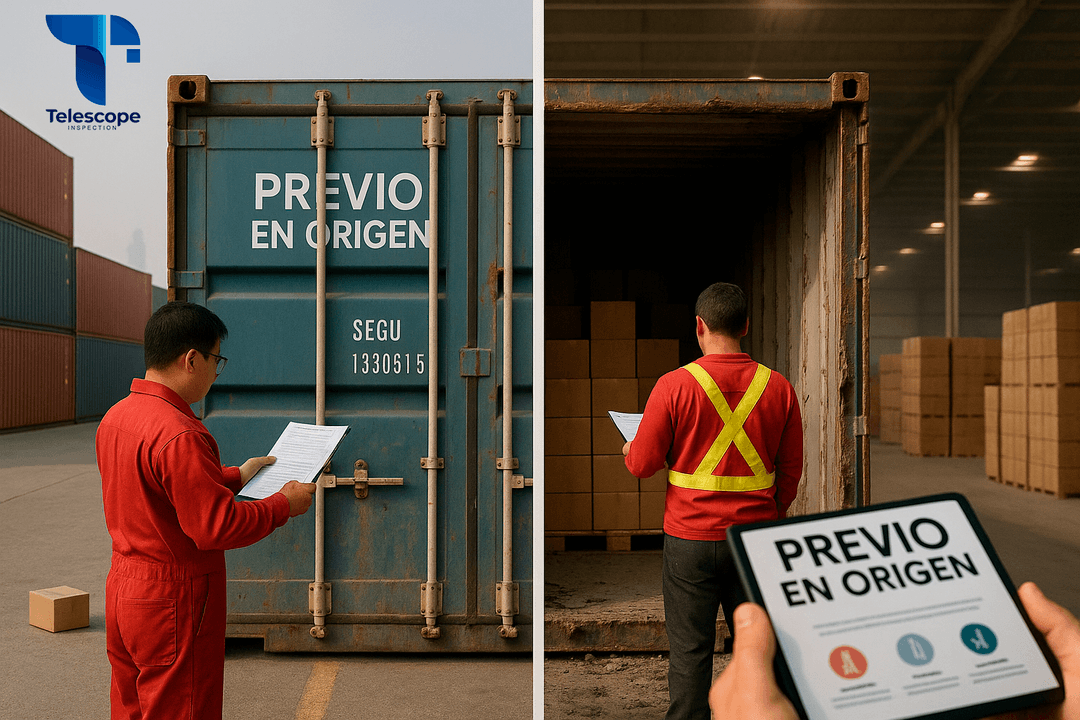
In the competitive world of retail in Mexico, large retail chains depend on large-scale imports to stock their stores with quality products, on time. Much of this merchandise comes from Asia and other international markets, which adds risk to the supply chain. Unexpected delays, documentation errors or hidden quality problems can translate into additional costs and lost sales.
One essential strategic tool for mitigating logistics and operational risk is the Previo en Origen (Container Loading Inspection) service provided by Telescope Inspection, which stands out for its broad, information-driven approach. Unlike other agencies that limit themselves to issuing standardised customs compliance reports, our inspection goes further: a detailed physical verification of the goods is carried out in the country of origin, right before shipment, with the primary purpose of facilitating customs clearance in Mexico and ensuring that what is shipped corresponds faithfully to what is declared.
At its core, Previo en Origen works as a comprehensive preventive control that validates key aspects such as packaging, quantity, labelling and the product's general logistics conditions. Although this service is not formally designed as a quality control —that is, its purpose is not to approve or reject production— in practice it acts as a first line of defence within the supply chain, identifying potential risks that could compromise product integrity or regulatory compliance. Because it is carried out before the goods leave the factory, it makes it possible to detect irregularities or damage in good time which, if not reported at origin, could cause significant harm at destination.
Below we explore two real cases that illustrate the strategic value of the Previo en Origen delivered by Telescope Inspection. In both scenarios —one in the furniture sector and the other in Christmas seasonal products— early inspection allowed the companies to make informed decisions, protect their interests and avoid far worse outcomes. These examples show how, well beyond a logistics formality, Previo en Origen provides critical information for decision-making and risk mitigation in large retail chains.
Case 1: Sofas – "White Ant" Infestation Detected in Time
Business context: A well-known Mexican retail chain had ordered a sizeable batch of sofas manufactured in Dongguan, China, a global furniture manufacturing hub. This was a major order for the season, intended to supply multiple stores with a new sofa model. Expectations were high: the sofas had to arrive in excellent condition and on time, since any delay or quality problem could affect sales and end-consumer satisfaction.
Before the furniture was shipped, a Previo en Origen inspection was scheduled at the supplier's factory in Dongguan, carried out by Telescope Inspection. During container loading, the inspector performed the usual first mile verifications: unit count, packaging review, container condition and documentation. In the middle of this routine process, however, an unexpected finding emerged. On closely examining the wooden and fabric base of one of the sofas, the inspector noticed small holes, along with tiny whitish insects moving inside the cracks. These signs pointed to the possible presence of "hormiga blanca" (white ant), the colloquial term used for termites.
Technical findings: The inspection confirmed an active termite infestation in the wooden components of several sofas. Small swarms of insects were hiding inside the internal structures of the bases and legs of the furniture. This finding was critical, since an infestation of this kind could destroy the product and even spread through the retailer's warehouses or stores in Mexico.
Documented evidence: The Telescope Inspection team proceeded to gather exhaustive evidence of the situation. The inspection report included high-resolution photographs of:
• The insects found on and inside the sofas, showing their appearance in detail (hormiga blanca).
• Visible damage to the wood (holes and the fine sawdust produced by termite activity).
• The conditions of the loading and storage area at origin, showing stacks of timber stored without any pest control.
In addition to the images, the inspector recorded details such as the number of affected pieces, the container identification, the date and time of the inspection, and comments from the supplier's on-site staff. All of this information was captured in a detailed report that was sent to the client immediately, before the container sailed from China.
Notification and decision-making: On receiving the report, the retail chain's executives faced an urgent decision. Stopping the shipment to demand a solution from the supplier (replacing or fumigating the products, for example) would have been ideal in quality terms, but it meant significant delays that could cost them the season's selling window. Weighing the options, the client chose not to stop the loading at origin, on the grounds that most of the merchandise was in good condition and that a delay would be more damaging commercially.
That decision did not mean ignoring the problem. Thanks to the Telescope Inspection report, the retailer had solid evidence of the situation, which allowed it to notify the supplier of the infestation detected (laying the groundwork for a claim) and to alert its insurer to a possible cargo loss, anticipating any claim on arrival.
Strategic value of the report:
• Assignment of liability and financial backing: The evidence demonstrated that the infestation originated at source, strengthening the retailer's position in holding the supplier accountable. With irrefutable proof, the supplier could not evade its obligation to compensate for the damage. The report also served to trigger the cargo insurance if needed, preventing the company from absorbing the losses.
• Protection of the supply chain and the customer: Informed in advance, the logistics teams in Mexico handled the merchandise with caution on arrival. The affected units were inspected and fumigated as soon as they landed, preventing the pest from being introduced into the chain's warehouses or stores and safeguarding consumers' property.
• Business continuity with minimal impact: Despite the setback, the company was able to execute its sales plan with almost no disruption. The sofas arrived on time and, excluding the infested pieces that were withdrawn, the rest of the inventory was sold as planned. Previo en Origen acted as a risk buffer: it flagged the problem in time and made it possible to pass the costs on to the supplier or the insurer, keeping the season's profitability intact.
What would have happened without Previo en Origen? In all likelihood, the infestation would have been detected by the customs authorities in Mexico during the PROFEPA inspection, when the container was examined at the port. In that case, corrective measures would have been immediate and severe: emergency fumigation, partial or total destruction of the merchandise, or even the return of the entire shipment to the country of origin. The consequences of that scenario would be devastating: extraordinary costs, total loss of the investment in those products, and a supply breakdown in stores right in peak season.
Worse still, if the problem had gone unnoticed at the point of entry, the pest would have reached the client's warehouses, where late detection would have forced internal sanitary protocols to be triggered, including fumigation, isolation of merchandise and even disposal of compromised products. That would translate into unusable inventory, logistics delays and direct losses from products that could not be sold.
By contrast, the timely intervention of Previo en Origen made it possible to generate evidence in advance, alert the client and take informed decisions before shipment, averting a potential logistics, financial and commercial disaster for the retail chain.
Case 2: Christmas Trees – Rust on Metal Components Identified at Origin
Business context: The second case takes us to the Christmas season, critical for retail chains because of the high volume of seasonal products sold in a short period. A major Mexican department store chain imported a massive batch of artificial Christmas trees from Huizhou, in Guangdong, China, aiming to have them in its branches before November. These trees included metal structures and stands to ensure their stability. The company expected to receive every unit in perfect condition, ready for sale, since any defect in such an emblematic product could translate into returns and complaints in the middle of the holiday season.
The executives scheduled a Previo en Origen inspection at the supplier's plant, carried out by Telescope Inspection. The logistics calendar was tight: the shipment had to leave on schedule in order to reach Mexico before the holidays, leaving little margin for setbacks.
Technical findings: During the inspection at origin, Telescope Inspection personnel supervised the loading of the containers. At first everything appeared to be in order (correct quantities, packaging and labelling). However, on reviewing some units, the inspector noticed clear signs of rust on several metal parts of the trees that should have been free of corrosion. Rust stains covered these pieces, indicating that the product had probably been exposed to excessive humidity or lacked an adequate anti-corrosion coating. This defect was not limited to an isolated sample; it appeared consistently, revealing a widespread problem. It was also observed that the supplier's warehouse had a high level of ambient humidity, which may have contributed to the premature rusting of the metal.
Documented evidence: As part of the Previo en Origen, the situation was carefully documented for the client report. The report included:
• Close-up photographs of the corroded metal components, clearly showing the areas affected by rust.
• Images of the warehouse area inside the factory, evidencing humid conditions near the tree inventory.
• A record of the weather conditions during the inspection and loading, including the humidity percentage.
With this proof in hand, Telescope Inspection's detailed report was sent immediately to the client in Mexico, before the final consolidation of the shipment.
Notification and decision-making: On learning of the corrosion problem, the retailer weighed the severity of the defect against the immovable deadlines of the season. Cancelling or delaying the shipment at that stage was unviable, since it would have meant not having enough merchandise in time to move onto the sales floor before November. It therefore decided to go ahead with the shipment despite the defect identified, avoiding stockouts in stores.
Even so, thanks to Previo en Origen, the company was able to prepare rather than react blindly. With the technical report in hand, it notified the supplier about the condition of the product, backing the communication with photographic evidence and placing its objection on record for future claims. At the same time, an arrival mitigation plan was set in motion internally: the distribution centres were instructed to inspect the metal components of every tree as soon as they were unloaded and to set aside any damaged unit before sending it to store. The aim was to prevent an end customer from discovering the defect on the sales floor. In addition, the team considered quick corrective measures to ensure the products looked right at the point of sale.
Strategic value of the report:
• Support and allocation of liability: The report left clear evidence that the failure occurred at origin and was not caused by the importer's handling. This freed the company from internal blame and gave it grounds to demand solutions from the supplier. If necessary, that documentation would also serve to support a claim under the cargo insurance or any legal action, protecting the company financially.
• Protection of the customer experience: With advance information, the company acted proactively, screening out or repairing the damaged products before putting them on sale. This substantially reduced the risk of damaged product reaching the sales floor and, with it, mass returns or customer complaints during the peak season, preserving consumer trust and the retail chain's good image right in the middle of the Christmas period.
What would have happened without Previo en Origen? Without this inspection, the corrosion would have been discovered far too late, possibly already in the stores, when customers began to notice it. The retail chain would have faced returns and complaints in the middle of the Christmas season, losing sales and suffering reputational damage. Moreover, not knowing the cause of the problem in advance, valuable time would have been lost investigating whether the defect occurred in transit or in the local warehouses, all of it under pressure. By contrast, thanks to the early warning from Previo en Origen, the company was able to get ahead of the issue and prevent a quality setback from turning into a commercial crisis.
Conclusion
The cases presented are compelling proof that Previo en Origen is far more than a customs formality; it is a strategic tool for protection and control in the supply chain of large retail chains. In both examples, this preventive service acted as an advance guard, detecting serious problems (pests, corrosion) while there was still time to react. The value delivered was reflected in informed decisions that saved costs and maintained business continuity.
For senior retail executives, embedding Previo en Origen inspection as a core, routine part of their import operations means securing a first line of defence against the unexpected. It is equivalent to minimising surprises when the merchandise is received and being able to manage any incident proactively, with evidence in hand. Although its primary objective is not to assess product quality, in practice its contribution as a preventive tool proves invaluable. By uncovering inconsistencies, damage or hidden risks in time, this type of inspection allows the company to adjust course before the problem escalates —whether by negotiating with suppliers, activating insurance or taking corrective measures to mitigate the impact in stores.