
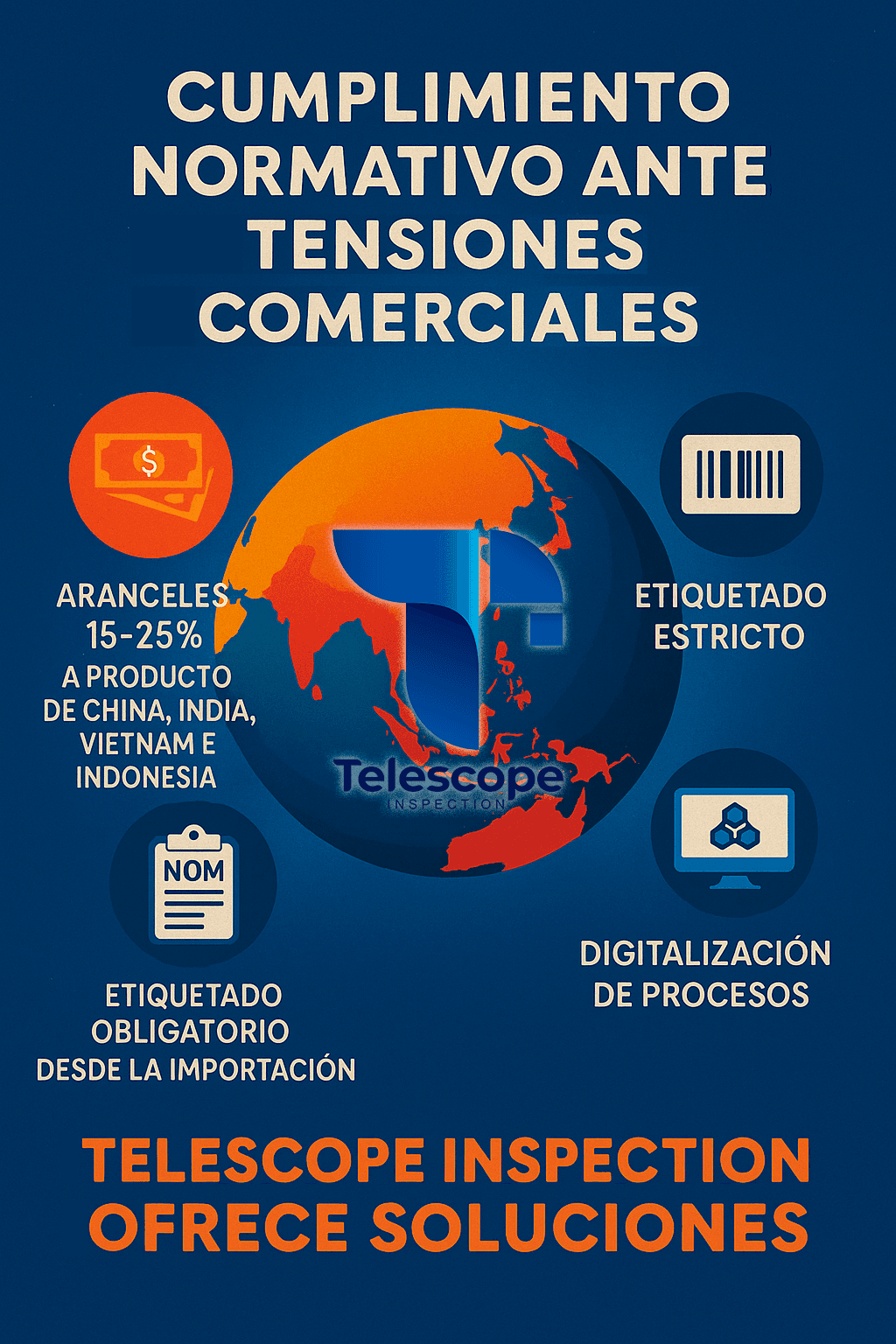
Throughout 2023–2024 the Mexican government has tightened its foreign trade policy, introducing new tariff and regulatory measures to protect domestic industry. Additional duties of 15–25% have been imposed on goods imported from countries with no free trade agreement in force (such as China, India or South Korea) in key sectors including footwear, plastics, glass and ceramics. In addition, as of January 1, 2025, a single 19% duty applies to goods originating in countries without an FTA (for example, courier shipments from China and India). In parallel, a 35% duty was decreed for textiles and apparel –clothing (dresses, shirts), household articles (blankets, curtains)– as well as camping gear and awnings imported through platforms such as Shein or Temu. These measures seek to curb the entry of goods that avoid taxes and to secure a more level playing field for Mexican industry.
• 15–25% duties: applied to goods from China, India and South Korea (no FTA) in categories such as footwear, plastics, glass and ceramics, among others.
• 19% duty: courier shipments from countries without an FTA (China, India, Indonesia) pay 19% at customs. For the United States and Canada (T‑MEC) the rate was set at 17% within certain value ranges.
• 35% duty: a special levy on textiles and clothing (dresses, shirts), as well as household articles (blankets, curtains) and camping gear.
• Strict labeling: the Ministry of Economy (Secretaría de Economía) has required mandatory compliance with labeling standards (NOM‑050 and others) since October 1, 2024; these products may no longer be imported without proper labeling under so-called “non-commercialization letters”.
Trade agreements and tariff exemptions
Despite these restrictions, some Asian goods can still arrive with reduced or zero duties thanks to agreements currently in force:
• Japan: Mexico has an Economic Partnership Agreement (in force since 2005) that eliminates or reduces duties on a wide range of Japanese products.
• CPTPP: Mexico is a party to the Trans-Pacific agreement (CPTPP), which includes Asia-Pacific countries such as Vietnam, Malaysia and Singapore (and Japan). Imports from these countries enjoy preferential access with reduced or zero duties on many products.
• No FTA in place: China, India and Indonesia have no agreement with Mexico, so their exports enter subject to ordinary duties (including the new levies mentioned above).
• South Korea: currently has no FTA with Mexico (a possible agreement is only under negotiation); its products therefore also pay general duties.
Changes in official standards and regulations
Beyond tariffs, several technical and tax rules have also been adjusted:
• Mandatory labeling: The Ministry of Economy published a notice to customs requiring that products subject to labeling standards (textiles, footwear, electronics, food, beverages, cosmetics, toys, etc.) demonstrate compliance with the applicable NOM as from the moment of importation. This prevents such goods from being imported “under protest” without the proper label.
• E-commerce tax: In the 2025 Miscellaneous Tax Resolution and the General Foreign Trade Rules, the SAT (Mexico’s tax administration) establishes that foreign digital platforms (Shein, Temu, Amazon, etc.) selling in Mexico must register with the Mexican Federal Taxpayer Registry (RFC) and charge VAT (16%) on sales to Mexican users. From 2025 onward, these platforms must withhold and report that VAT.
• CFDI per transaction: The new rules require these platforms to issue a digital tax receipt (CFDI) for each sales transaction, and to report information such as bank accounts and the countries of origin of their sellers. This additional tax control raises the traceability of every transaction.
• Reinforced customs controls: The SAT announced stronger physical inspections at customs in order to fight abusive practices and the undervaluation of goods in international parcel imports. In practice, this means the authorities will scrutinize the contents and documentation of shipments far more closely.
These regulatory changes significantly raise the bar for importers, who must now ensure that every shipment complies with the correct tariff classification, the required certificates of origin and labeling, and, on top of that, the new tax obligations. Pre-shipment documentation, electronic records and internal verifications all increase, since any non-compliance can translate into fines, seizures or clearance delays.
Origin inspection services make it possible to guarantee compliance with customs rules from the very beginning of the supply chain. This optimizes import lead times and mitigates the associated risks. Telescope Inspection, for example, deploys digital solutions (blockchain-based) to preserve the integrity and availability of the information gathered during the inspection.
Recommendations and solutions from Telescope Inspection
To meet these requirements, we recommend that Mexican importers adopt proactive measures and rely on specialized services:
• Previo en Origen (Container Loading Inspection): Carry out an inspection in the exporting country, before the goods are shipped. Telescope Inspection performs these detailed container reviews, verifying packaging, labeling, shipping marks and quantities. Based on the information obtained, the customs broker can file the customs pre-entry even before the goods arrive, achieving faster and safer clearance.
• Document verification: Before shipment, make sure that invoices (CFDI) and certificates meet SAT requirements and the applicable NOMs. Correct tariff classifications and declared values in good time. This avoids discrepancies at customs that could trigger penalties.
• Trademark registrations: Ensure due compliance with the Federal Law for the Protection of Industrial Property, confirming in advance that the brands of the products to be imported are duly registered and that the importer holds the necessary authorizations.
• Digital transformation of processes: Implement digital systems for supply chain management. Telescope Inspection digitalizes cargo inspection and stores the data on blockchain (Sistema Efficax), enabling secure, transparent tracking of every shipment. This technological traceability makes it easier to evidence compliance in audits and speeds up coordination with customs brokers.
• Ongoing advisory: Stay in contact with foreign trade specialists to keep up to date on applicable NOMs and on SAT and Ministry of Economy provisions. Telescope Inspection combines origin inspection with consulting, ensuring full compliance with Mexican customs regulations.
Putting these recommendations into practice helps avoid penalties and delays. With origin inspection and prior document verification, inconsistencies are detected before the goods are shipped. Digitalization and the use of real-time data support efficient compliance management. Taken together, Telescope Inspection’s services (origin inspection, document audit and digital platforms) strengthen the supply chain, facilitate customs clearance and protect the importing company against the new regulatory requirements.
The recent changes in Mexican tariffs and regulations noticeably raise the level of compliance demanded from importers. Anticipating them with robust inspection and verification processes is essential. Comprehensive services such as those provided by Telescope Inspection offer key solutions (pre-shipment inspection, digital certifications and blockchain tracking) to adapt to these requirements, avoiding penalties and ensuring swift clearance in line with the customs law in force