
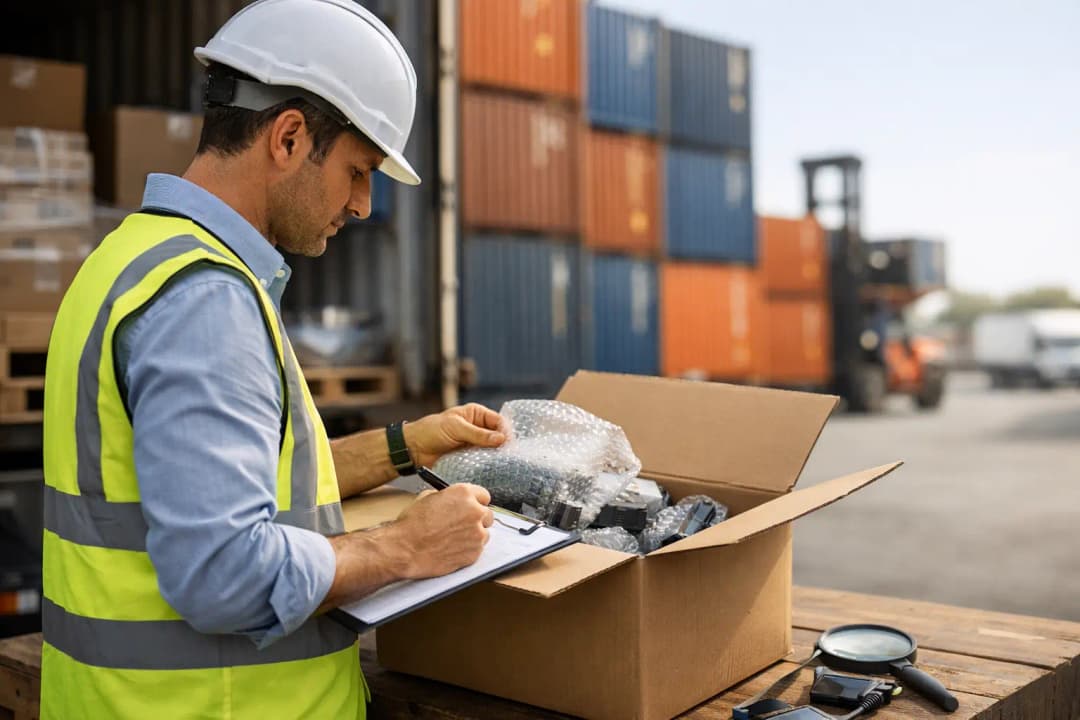
If you are importing from Asia and your customs broker has mentioned "Previo en Origen," you likely have two questions: what it is, and what it costs. The first has a clear technical answer. The second has an answer different from what most people expect.
What Previo en Origen is
Previo en Origen is the physical and documentary review of your goods in the country where they are produced and shipped, before they are loaded into the container. It is not a quality inspection or a production control: it is the verification that what travels in that container — in product, quantity, documentation and loading conditions — matches what you will declare before Mexican customs.
That difference matters. A quality inspection answers the question "is the product well made?". Previo en Origen answers a different and more urgent question: "will what leaves here allow me to clear customs without surprises in Manzanillo, Lázaro Cárdenas or Nuevo Laredo?".
In Mexico, Previo en Origen is executed with the operational logic that Mexican customs clearance demands: merchandise identification, correspondence with the tariff classification, consistency of commercial documents, and a record of the actual condition of the cargo on the day the container is closed.
What it actually reviews
A well-executed Previo en Origen covers four fronts:
Product and quantity. It verifies that what was shipped matches what was invoiced: models, styles, SKUs, quantities per carton and total pieces. Differences found at origin are corrected at origin; found at the port, they become an observation.
Documentation. The commercial invoice, packing list and loading plan are checked against what is physically on the loading platform. A packing list that does not match the container is one of the most frequent causes of clearance delays.
Loading conditions. The condition of the container, the seal number, conditions at the site, and the date and time of closing are recorded. This is what later allows you to demonstrate how the cargo was travelling when it reaches destination.
File. Everything above is documented so that the importer and its clearance team can use it. Previo does not end with "everything is fine": it ends with organized, searchable evidence.
Why it is done before shipment
Because the cost of correcting changes from place to place. At the factory, correcting a labelling discrepancy takes hours. At the destination port, the same discrepancy means storage, handling, delays and, in the worst case, a previo redone against the clock.
The logic of Previo en Origen is not preventive out of romanticism: it is economic. You pay for a small verification to avoid a large correction.
What does Previo en Origen cost?
Here it is worth being direct, because this is the most frequently asked question and the one the market answers worst.
The cost of Previo en Origen is not a determining factor in the cost of your import. It is a marginal line item compared with the value of the cargo and with the set of costs you already pay to bring the merchandise in: freight, insurance, tariff, VAT, handling, storage and clearance fees. In a typical operation, the inward cost equals more than the FOB value of the goods. Within that structure, Previo is a minor fraction.
Think of it as insurance. The premium is small; the loss it prevents is not. And unlike traditional insurance, Previo en Origen also produces an asset: the record of what actually left the factory, with dated and verifiable evidence.
Its cost is small; its absence is not.
A single port delay — due to an inconsistent packing list, a quantity discrepancy, or a container with no recorded condition — costs more than many previos combined. An importer does not choose Previo for its price. They choose it because they already know the cost of not doing it.
Where our cost comes from
The cost of each operation is defined by its real volumes. What does not change is where our cost structure comes from, and that is the advantage:
We are producers of the service, not intermediaries. We do not subcontract inspectors or resell a third party's inspection. Our operation executes the work directly, with no commercial layers between our people and your cargo. That allows us to operate with lean cost structures and come to market at a highly competitive cost.
What you get with Telescope Inspection
We are pioneers of Previo en Origen in Mexico: we have been doing this work for Mexican importers since 2009, with a company established in 2006.
Four things sustain that work:
Operational experience. More than 300,000 containers inspected at origin.
Verifiable track record. None of those containers has required the previo to be redone at the port due to causes attributable to the inspection.
Global coverage in more than 85 countries, with our own infrastructure: we do not subcontract inspectors. Wherever you buy, we go.
Digital file. Every inspection is recorded with dated evidence, consultable by the importer and usable by their clearance team.
Add to that ISO 9001 certification and one simple operating principle: if something was not verified, it is not reported as verified.
What Previo en Origen is not
To avoid common confusion:
- It is not a product quality inspection.
- It does not replace the reviews that are already part of your clearance process.
- It does not guarantee that customs will not examine the cargo; it guarantees that you have something to answer with if they do.
- It is not paperwork: it is a physical operation at the factory or at the consolidation point.
Frequently asked questions
Is Previo en Origen mandatory? Not in the sense that the law requires contracting a private service. But origin evidence has become decisive for clearance without observations, and most importers operating with volume integrate it into their process.
Can I use my own inspector? At Telescope Inspection, no. We work exclusively with our own personnel, with our own methodology and training. We do not validate or revalidate third-party reports.
What happens if the factory does not allow access? It is reported to the client. We do not issue a report on what was not verified.
What if my supplier is a trading company? The inspection is performed at the point where the merchandise is consolidated and shipped, which is where what actually enters the container is defined.
Can I know what it would cost in my case? Yes, with a quote. And it is worth requesting it with your real volumes, because that is the only way the figure means anything.
Previo en Origen does not compete on price with anything: it competes against the cost of discovering the problem too late. If you want to know what it represents for your specific operation, we will gladly review it with your numbers.