
Direct answer
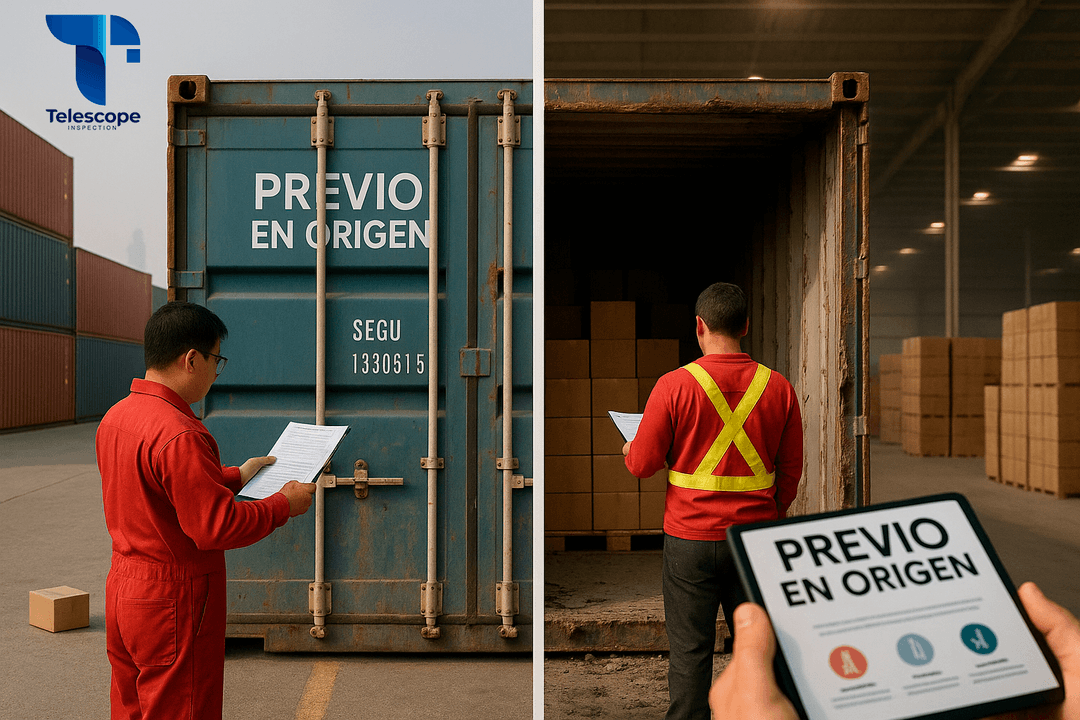
Previo en Origen (PEO) — Telescope's inspection at origin before shipment, applying Mexican customs criteria.
Verification of merchandise at origin is the physical and documentary inspection of the merchandise at the factory or warehouse in the country of origin, before shipment, applying the criteria Mexican customs will demand. Your customs broker asks for it because it transfers less risk to them: they receive a file that supports what is declared on the entry declaration — product, quantity, presentation, labeling, container condition and loading circumstances. As of 2026, with the Customs Law reform, this file stops being a good practice and becomes a documentary necessity.
Table of contents
- What exactly is a verification at origin?
- How is Previo en Origen different from customs examination?
- What does a Previo en Origen verify?
- Why does your customs broker ask for it?
- What is the defense file?
- Why is the moment of loading the key moment?
- How does this change with the 2026 reform?
- Comparison: without verification vs. with verification at origin
- When is it worth contracting?
- Telescope Inspection and Previo en Origen
- Frequently asked questions
- How Previo en Origen fits in
- Sources
What exactly is a verification at origin?
It is an inspection performed before shipment, at the point where the merchandise physically exists and can still be corrected. It has three defining characteristics:
| Characteristic | What it means in practice |
|---|---|
| It is done at origin | At the factory or warehouse where it is produced or consolidated |
| Before shipment | The merchandise is not yet in transit |
| With Mexican customs criteria | Not a generic "international" criteria: the one applied by the customs of the destination country |
It is not a supplier audit. It is not an evaluation of the product's technical specification. It is verification of the merchandise against what is going to be declared, with documentary evidence.
What is NOT a verification at origin?
| It is not | Why |
|---|---|
| Technical evaluation of the product | The criteria is customs, not technical specification |
| Factory audit | That is another category of service |
| Customs examination | That is done by the authority, at the port, and is random |
| Release guarantee | No service prevents customs examination |
| Tax procedure | It is physical and documentary verification |
How is Previo en Origen different from customs examination?
This is the most common doubt — and the most important to clarify, because it defines real expectations.
| Variable | Previo en Origen | Customs examination |
|---|---|---|
| Who does it | Verification company at origin | Mexican customs authority |
| Where | Factory / warehouse at origin | Customs facility in Mexico |
| When | Before shipment | On arrival and activation of clearance |
| Criteria | What Mexican customs will apply | The authority's |
| Randomness | Not applicable | It is random |
| Can findings be corrected | Yes, there is still time | No, it has already arrived |
| Evidence generated | Defense file | Authority's record |
Does Previo en Origen prevent customs examination?
No. Customs examination is an authority power and its activation is random. No private verification prevents or guarantees it.
What Previo en Origen does is something else, more valuable: when the examination occurs, the importer already has a file that supports what was declared. Instead of explaining at the port what was not documented, they present what was documented at the moment of loading.
What does a Previo en Origen verify?
| Area | Verification |
|---|---|
| Merchandise | Description against invoice and packing list, quantity, model, presentation |
| Packaging and labeling | Applicable NOM — NOM-050 (general) and NOM-051 (food and beverages) |
| Documentation | Commercial invoice, packing list, coherence between documents |
| Container | Physical condition, cleanliness, integrity, container number, seals |
| Loading | Date, time, conditions, stowage method |
| Circumstances | Weather that day, conditions of the loading site |
| Evidence | Photography, video, digital record with timestamp |
Why does verifying the container and the weather matter?
Because they are the two variables nobody can reconstruct afterwards and the ones most used to explain damage or an inconsistency. If the merchandise arrives wet, the first question is whether the container was dry and in good condition when it was loaded. If nobody documented it, there is no answer.
The defense file includes: condition of the merchandise, condition of the container, date, photos and weather. The day it is loaded is the key moment — after that, any condition is attributed to the transit.
Why does your customs broker ask for it?
For four concrete reasons that intersect with their own risk:
1. The agency answers for what it signs
After the 2026 reform, the liability exemptions of the customs broker are repealed. The broker has less room to "cover" what is not well documented, and that is why they ask for more evidence. See Customs Law 2026: Changes for Importers.
2. The entry declaration must hold up
An entry declaration states description, tariff code, quantity, value and origin. When a later verification arrives, the broker must be able to demonstrate that the declaration was correct at the time of clearance. The origin file is that demonstration.
3. It avoids costly reviews
An error detected at origin is corrected with a phone call. An error detected at the port is corrected with time, money and, in the worst case, with a precautionary embargo (for example, for non-compliance with labeling NOM).
4. It protects their license
An agency with a 20-year extendable license has long-term incentives. Verifying at origin is part of operating with that horizon.
Put simply: your agency does not ask you for Previo en Origen to charge you for a procedure. It asks you because it saves them a problem that will later fall on them.
What is the defense file?
It is the organized evidence that allows responsibilities to be delimited when something turns out different from what was declared. It has three components:
| Component | What it contains | What it is for |
|---|---|---|
| Customs compliance | Documentation, classification, NOM, labeling | Supporting the entry declaration |
| Delimitation of responsibility | Who verified, when, what they found | Correctly attributing what happened |
| Evidence of loading circumstances | Photos, date, condition of merchandise and container, weather | Explaining the conditions of the moment |
Why "defense" and not "control"?
Because the value is not in preventing a quality error, but in being able to explain what happened, when and under what conditions. A defense file does not say "everything is fine": it says "this is what was there, someone saw it, on this date, with these photos".
Why is the moment of loading the key moment?
Before loading, the merchandise is in a controlled place. After loading, it is in the hands of a carrier, a port, a vessel and another port. The chain of custody becomes long and difficult to reconstruct.
| Before loading | After loading |
|---|---|
| The merchandise can be inspected in full | Only what arrives is inspected |
| The container can be photographed empty and sealed | The container has had several hands |
| Labeling can be corrected | The error can only be reported |
| The day's weather is documented | The weather is a hypothesis |
| Responsibility is identifiable | Responsibility blurs |
The day it is loaded is the key moment. It is the only date on which the merchandise and the container can be documented together, at the place of origin, with a customs criteria.
How does this change with the 2026 reform?
The Customs Law reform (in force January 1, 2026) pushes in three directions that coincide with Previo en Origen:
| Change of the reform | Effect on verification at origin |
|---|---|
| New minimum documentation | The origin file becomes part of the customs file |
| Proof of rules of origin | Evidence at origin supports the declared origin |
| Greater traceability | The record of the moment of loading is pure traceability |
| Precautionary embargo for NOM | Labeling verification at origin prevents arriving without compliance |
| End of the broker's exemptions | The broker demands more evidence before signing |
Comparison: without verification vs. with verification at origin
| Variable | Without verification | With verification |
|---|---|---|
| Knowledge of the merchandise before shipping | Depends on the supplier | Verified |
| NOM labeling | Reviewed at the port | Reviewed at the factory |
| Container condition at loading | Not documented | Documented with photos |
| Weather on the day of loading | No record | Recorded |
| Delimitation of responsibility | Difficult | Documented |
| Customs broker's stance | More questions | File ready |
| Risk of delay due to documentation | Medium | Low |
| Risk of reconfirmation at the port | No change (random) | No change, but with evidence |
| Risk of embargo for NOM | High | Reduced |
The key row is reconfirmation: Previo en Origen does not prevent customs examination. What it reduces is documentary risk and compliance risk.
When is it worth contracting?
| Situation | Worth it? | Why |
|---|---|---|
| First shipment with a new supplier | ✅ Yes | Validates merchandise, container and process |
| Product subject to labeling NOM | ✅ Yes | The 2026 precautionary embargo makes reviewing first critical |
| High-value or fragile product | ✅ Yes | The condition at loading determines who answers |
| Merchandise with origin under a treaty | ✅ Yes | Proof of origin and evidence support the benefit |
| Supplier with a track record | ✅ Recommended | Reduces variability |
| Small sample shipment | ⚠️ Evaluate | The container model applies less |
| Low-value parcel | ❌ Normally not | Different model (see minimis regime) |
Telescope Inspection and Previo en Origen
Telescope Inspection performs Previo en Origen since 2009, with the criteria Mexican customs will apply, and produces the complete defense file: verifiable customs compliance, delimitation of responsibility and evidence of loading circumstances.
Everything is recorded in Efficax (blockchain, legally recognized in Mexico since June 2023) and Cargo Passport, Telescope Inspection's digital evidence record.
More than 300,000 containers inspected in 20 years, with a statistical record of 0% of incidents that required redoing the inspection at the port. ISO 9001 certification. Global coverage with own inspectors — not subcontractors — in more than 85 countries.
Frequently asked questions
Does Previo en Origen replace customs examination?
No. Customs examination is done by the authority and is random. Previo en Origen is prior, private and documentary verification.
Does it guarantee my container passes without inspection?
No, and distrust anyone who promises it. What it guarantees is evidence and documentary compliance.
How long before shipment should it be done?
It is done at the moment of loading or immediately before, when the merchandise is complete and the container available. The moment of loading is the key moment.
Is 100% of the merchandise inspected?
The scope depends on the type of merchandise and the verification plan. What is constant is that the critical variables are reviewed: product, labeling, quantity, container and loading circumstances.
Does it work if my supplier is from a country without a treaty?
Yes. The criteria is Mexican customs, not preferential origin. Coverage is global.
What happens if the verification finds a problem?
It is documented and corrected at origin, before shipment. That is the value: the problem does not travel.
Does the file serve before a later verification by the authority?
Yes. The defense file exists precisely to support what was declared when the authority reviews afterwards.
Can I request it for a single shipment?
Yes. It can be contracted per shipment or as a recurring scheme.
Does it apply to air or land cargo?
The verification criteria is the same; the mechanics change. Telescope Inspection's coverage is global and includes cargo in different modes.
How Previo en Origen fits in
Telescope Inspection does this since 2009 and produces the complete defense file: verifiable customs compliance, delimitation of responsibility and evidence of loading circumstances.
The Previo en Origen delivers three things that cannot be recovered afterwards:
- Verifiable customs compliance — product, documentation and NOM reviewed at the factory or warehouse.
- Delimitation of responsibility — a record of what was found, when and under what conditions.
- Evidence of loading circumstances — condition of merchandise and container, date, photos, weather.
Everything is recorded in Efficax (blockchain, legally recognized in Mexico since June 2023) and Cargo Passport, the digital evidence record.
More than 300,000 containers inspected in 20 years, with a statistical record of 0% of incidents that required redoing the inspection at the port.
Telescope Inspection has operated since 2006 and is ISO 9001. Global coverage with own infrastructure — own inspectors, not subcontractors — with a presence in more than 85 countries. Operating languages: Spanish, English, Chinese and Vietnamese.
If your agency asks you for verification at origin, ask for the complete file. The difference between "we reviewed it" and "here is the evidence of what was loaded on day X" is the difference between a procedure and a defense.
Sources
- Chamber of Deputies — Current text of the Customs Law: https://www.diputados.gob.mx/LeyesBiblio/ref/ladua.htm
- SAT — General Rules of Foreign Trade 2026: https://www.sat.gob.mx/minisitio/NormatividadRMFyRGCE/documentos2026/rgce/compiladas/1raRMRGCEpara2026.pdf
- ANAM — Customs examination (official portal): https://www.anam.gob.mx
- DOF — Official Gazette of the Federation: https://www.dof.gob.mx
- Ministry of Economy — NOM-050-SCFI-2004: https://platiica.economia.gob.mx/normalizacion/nom-050-scfi-2004/
- KPMG Mexico — Customs Law Reforms: https://kpmg.com/mx/es/tendencias/2025/11/flash-reformas-a-la-ley-aduanera.html