
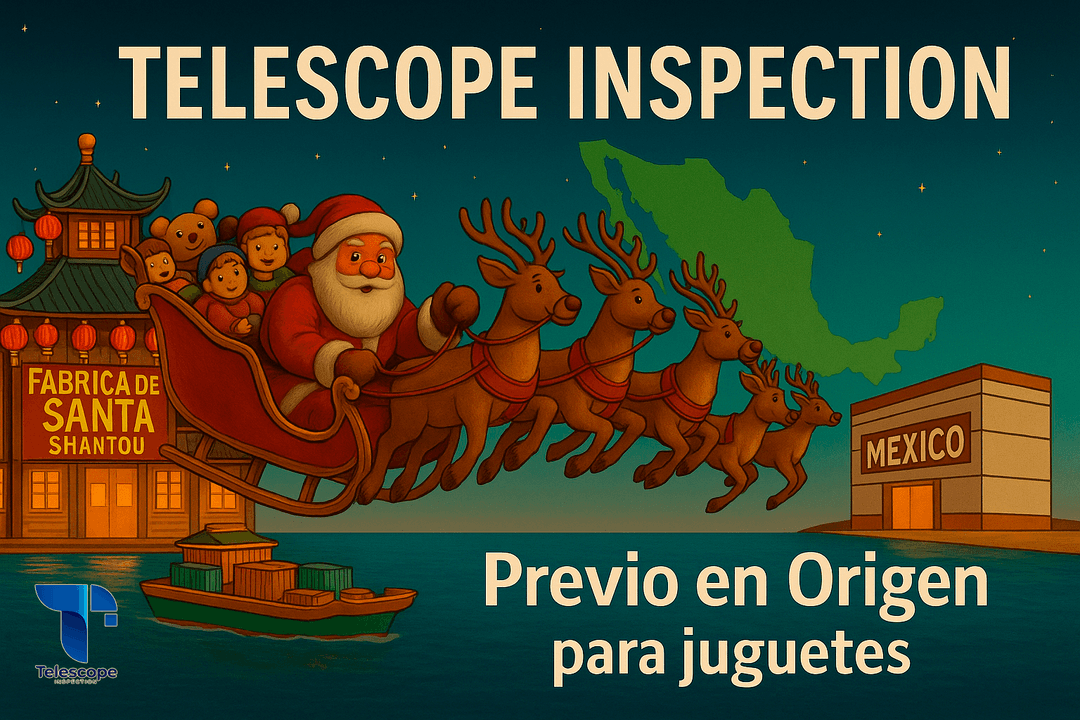
Mexican toy importers face the same challenge every year: bringing in thousands of products – from toy cars and dolls to plush toys and race tracks – in time for the Christmas season. In this context, Shantou, China, historically recognized as the largest toy manufacturing cluster in the world, plays a central role. In fact, one third of all plastic toys on the planet comes from the Chenghai district of Shantou, which has earned it the nickname of the "real Santa's Workshop". Unlike the mythical North Pole, in Shantou tens of thousands of factories run at full speed to stock toy shelves worldwide, especially in the run-up to Christmas. Given such large volumes and such critical deadlines, making sure these products meet every requirement right at the point of origin is essential for a successful, trouble-free import into Mexico. This is where Telescope Inspection's Previo en Origen (Container Loading Inspection) service comes in: an origin inspection solution that delivers multiple benefits in experience, coverage and capacity, securing regulatory compliance, accurate documentation, traceability and logistics efficiency all the way from Asia to Mexican Customs.
Shantou: the global toy epicenter (the "Santa's Workshop")
Shantou, and in particular its Chenghai district, has established itself as the heart of the global toy industry. In addition to the figure already mentioned – one third of the world's plastic toys – it is estimated that 70% of Chenghai's toy orders are destined for export. Its streets are lined with buildings where more than 50,000 toy businesses operate, many of them specialized in different links of the production process (molding, dyeing, assembly, packaging, and so on), which enormously increases efficiency in toy manufacturing. It is no surprise that even nearby cities such as Shenzhen (another Chinese manufacturing hub) depend on Chenghai for components: around 90% of its toy suppliers source accessories from Chenghai factories. In other words, Shantou is an irreplaceable pillar of the global toy supply chain, feeding not only Mexico's Christmas demand but that of the entire world.
Aware of this reality, Telescope Inspection has built a strong presence in Shantou in order to deliver its services directly at the source. Having local staff and coverage in the "toy capital of the world" allows Telescope to inspect toy shipments right at origin, accompanying the consolidation and loading process of full containers of merchandise. This is especially valuable during the year-end peak season, when Shantou truly operates as "Santa's workshop", dispatching containers packed with die-cast metal cars, colorful dolls, adorable plush toys and fast race tracks toward markets such as Mexico. Telescope Inspection's local presence in this region ensures that each of those containers can undergo a rigorous Previo en Origen, leveraging deep knowledge of the area and established relationships with local suppliers.
What is the Previo en Origen service?
In simple terms, Previo en Origen is a cargo inspection carried out in the country of origin of the merchandise, before shipment, with the specific purpose of facilitating and speeding up clearance at the destination customs office (in this case, Mexico). Unlike a traditional inspection that might take place when the cargo arrives in Mexican territory, Previo en Origen moves that verification to the moment the container is loaded at, for example, the factory or the Asian port. All the information gathered during the inspection is transmitted to the customs broker in Mexico, enabling them to file the customs pre-entry even before the vessel sails or arrives. In other words, by the time the container reaches the Mexican port, the documentation is already prepared and verified, allowing for practically immediate and secure customs clearance and eliminating unnecessary costs tied to delays (such as port storage, late fees, and so on).
It is important to stress that the focus of Telescope Inspection's Previo en Origen is different from a traditional quality control inspection. It is not about assessing the intrinsic quality of the product or approving/rejecting lots for manufacturing defects – it is not a supplier quality audit. Rather, it is an inspection geared toward customs and logistics compliance: verifying that what is being shipped matches exactly what has been documented, that packaging and labeling regulations have been followed, and that nothing is left open to interpretation or doubt at the time of importation. This clarity, obtained in advance, is the key to optimizing lead times across the supply chain and at customs.
During a typical Previo en Origen, Telescope Inspection deploys its inspectors to the loading site (whether the supplier's factory or a consolidation warehouse). Following its standardized methodological procedures, the team first coordinates with the supplier the date, time and place of the scheduled loading. On the agreed day, the inspector arrives on site and requests the shipment's packing list. With that document in hand, they begin physically cross-checking the merchandise against what has been declared. The conditions of the loading site and of the container are reviewed (for instance, that the container is clean, dry, free of damage and of unusual odors). As loading progresses, the process itself is verified: how the cartons are stowed, whether safety measures are observed, and so on. The packaging of the products is inspected, confirming that the cartons are properly sealed and protected. The carton markings (shipping marks and numbers) are also checked, along with the correct labeling with commercial information in Spanish or English as required (for example, country-of-origin labels reading "Made in China", barcodes, descriptions printed on the cartons). A critical aspect is counting the units: the inspector records the total number of cartons loaded and, through sampling, the number of pieces per carton, making sure the figures match the packing list and the invoice. In addition, the characteristics of the products are documented for tariff classification purposes – meaning, for example, noting the material composition of the toys (plastic, metal, textile), how they work (whether they are electric, battery-operated, etc.), dimensions, and any other relevant detail the customs broker will need in order to determine the exact tariff code and the regulations applicable in Mexico.
All of this verification is backed by comprehensive photographic evidence. The Telescope inspector takes photographs of the loading environment, of the interior and exterior of the container, of the stowed cartons and of the products themselves. That way, if we have a mixed container with, say, 500 cartons of die-cast metal toy cars, 300 cartons of vinyl dolls, 200 cartons of teddy bears and 100 cartons of electric race tracks, there will be a visual record of every product type, its packaging and its labeling. This evidence is not only invaluable in the event of disputes or clarifications; as we will see further on, it is also stored using blockchain technology to guarantee its integrity and traceability. Once loading is complete, the inspector issues a detailed inspection report compiling all findings, counts and photographs taken.
In short, Previo en Origen acts as a safety filter in the First Mile of the logistics chain: before the container is sealed and shipped out of Asia, Telescope Inspection verifies that its contents are in order, documented and ready to cross borders without surprises. Now, what concrete benefits does this bring to toy importers in Mexico? We will group them into four pillars: regulatory compliance, accurate documentation, traceability and transparency, and logistics efficiency – all of them interrelated.
Regulatory compliance and accurate documentation from the point of origin
One of the greatest benefits of Previo en Origen is securing compliance from the moment the merchandise is born. Mexico, like other countries, has strict laws and standards applicable to imported toys: safety and labeling NOMs, Spanish-language information requirements, age warning labels, certificates of conformity, among others. A mistake in any of these areas can result in customs holds, fines, or even the impossibility of selling the product. Through its origin inspection, Telescope Inspection verifies that the merchandise complies with Mexican customs laws and regulations, as well as with the applicable general labeling and standardization rules. In essence, the team carries out a commercial compliance inspection in the country of origin, checking that every carton and product carries the mandatory statements, labels or markings before being shipped. This is crucial, for example, with electric toys that require the NOM safety mark, or with plush toys that must carry fiber/textile labels and washing warnings: if a missing label is detected during the factory inspection, there is still time to correct it at origin, avoiding problems in Mexico.
Telescope Inspection was also a pioneer in developing operational standards specifically for this type of customs-oriented origin inspection. Its extensive experience (operating in China since 2008 for Latin American clients) has allowed the company to refine checklists and protocols tailored to Mexican requirements. A Mexican toy importer can be confident that Telescope's personnel know in detail what Mexican Customs and agencies such as the Ministry of Economy or Profeco require in terms of toy documentation and labeling. That is why they guarantee that all critical product information complies with regulations before shipment. This includes verifying key data such as: the precise name and description of each toy (to avoid incorrect tariff classifications), the predominant material (needed, for instance, for non-toxicity certificates on plastics), Spanish-language instructions where applicable, and supporting documentation (quality certificates, detailed packing lists, proforma invoices with consistent data).
The outcome of this preventive approach is accurate and complete documentation. With the Previo en Origen report in hand, the customs broker in Mexico can prepare the import pedimento (customs declaration) with full confidence, entering the correct tariff codes, declaring exact values and quantities, and attaching the compliance documents (NOM, certificates, etc.) knowing that they match the physical reality of the cargo. In many cases, the information obtained at origin even makes it possible to process required permits or notices in advance (e.g., toy safety notices, COFEPRIS registrations if a given toy requires them, etc.) while the vessel is still en route. This way, the classic guessing game about what is inside the container is avoided, as is the need to fix things on the fly, providing documentary certainty to both the importer and the authorities.
Traceability and transparency through blockchain technology
One differentiator of Telescope Inspection is its commitment to technological innovation as a way to deliver greater transparency and traceability across the supply chain. Aware that the information gathered during Previo en Origen is valuable, the company has developed the blockchain-based Efficax System, which fully digitizes the First Mile of the supply chain. What does that mean in practice? That all the data and images obtained during the inspection – from the serial number of the seal placed on the container to the photographs of those cartons of toy cars and dolls inside the container – are uploaded securely and immutably to a proprietary blockchain platform. This technology, legally recognized in Mexico since June 2023, provides an additional guarantee: the evidence generated at origin cannot be tampered with and is available in real time to authorized parties.
For the importer, this traceability means turning evidence into an insurance policy (as the company's motto puts it). Should any incident occur in transit (damage, random inspections, discrepancies), there is a tamper-proof record of the condition in which the merchandise left origin. This makes it easier, for example, to file cargo insurance claims by showing photos of the container properly loaded and sealed at origin, or to handle disputes with suppliers by demonstrating exactly what was loaded. In addition, the platform allows users to review all the information gathered online, reducing reliance on physical documents and improving transparency among everyone involved (supplier, importer, customs broker, freight forwarder, and so on).
From a logistics traceability standpoint, every container inspected at origin by Telescope can be uniquely identified and linked to a blockchain report. This adds a layer of protection against theft or tampering with the merchandise: if a seal arrives broken or the declared weight changes, the data on the blockchain can be checked immediately to detect anomalies. In short, the use of blockchain within Previo en Origen brings confidence and full visibility to the chain – something especially valuable when handling such large volumes of toys coming from different manufacturers and regions.
Logistics efficiency: faster and safer customs clearance
Perhaps the most tangible business benefit is the drastic reduction in customs clearance times delivered by Previo en Origen. Traditionally, a container arriving at a Mexican port could take an average of 5 to 8 days to complete all import formalities, especially if any inspection or inconsistency arises. With Telescope Inspection's model, however, clients have seen that time drop to less than 48 hours for containers inspected at origin. This means that within one or two days the container can be released from customs, ready for delivery to the importer's warehouse.
How is such a speed-up possible? Largely because customs clearance becomes a constant rather than an unknown variable. In other words, once the previo has been performed, surprises are eliminated: the customs authority receives a clean and complete entry file, which reduces the likelihood of the shipment being selected for physical examination (red channel). Even if an examination does take place, the information provided is so detailed that the official inspection becomes quick and conclusive. In many cases, these containers get the green channel immediately thanks to the trust built up by a track record of compliance. Telescope points out that its services turned a 5-to-8-day clearance into one of less than 2 days, an enormous gain in efficiency and speed.
Logistics efficiency is reflected not only in lead times but also in costs avoided. By improving the predictability of customs clearance and reducing delays, unnecessary costs associated with hold-ups are avoided. For example, every additional day of storage at the port or in a bonded facility means extra charges; likewise, delays can mean missing delivery windows with end customers (retailers) and even losing sales during peak season. With a Previo en Origen, the importer can schedule the arrival of products at the distribution center and at the stores with far greater certainty, making sure the toys are on the shelves right in time for Christmas sales. This turns the logistics chain into a more fluid and reliable process, where the arrival of a container is no longer a source of uncertainty or concern.
Another important aspect is risk mitigation: knowing exactly what is inside the container and in what condition reduces the risk of customs violations or penalties. For instance, if a toy had been misdeclared in value or quantity and this were not detected at origin, in Mexico it could be treated as a serious customs violation. Previo en Origen works as a control filter, detecting and correcting those discrepancies before they turn into legal problems. This gives the importer greater legal certainty, as they can demonstrate due diligence in compliance. In summary, products reach the warehouse on time and ready for distribution, with customs formalities already handled efficiently. Logistics benefits across the board: fewer days at the port, faster last-mile routes and satisfied customers who find their toys on time.
Regional coverage: from Shantou to Yiwu, Shenzhen, Vietnam and Thailand
Although Shantou stands out for its volume and importance in toys, the supply chain for these products spans multiple regions across Asia, and Telescope Inspection offers coverage in the main ones. In China, besides Shantou, another key location is Yiwu, in Zhejiang province. Yiwu is home to the most diverse wholesale toy market in the world, with more than 450,000 toy styles available, and the place where 1 out of every 4 toys in the world is traded. Many importers visit Yiwu to source a vast variety of items – from electronic toys to plush – and consolidate mixed containers there. With a presence in Yiwu, Telescope can perform origin inspections at the consolidation warehouses or factories in that area, ensuring that even those varied shipments meet the standards before leaving China.
Likewise, Shenzhen, part of the Pearl River Delta in Guangdong, is home to numerous technology companies and manufacturers of gadgets and electronic toys. While much of Shenzhen's toy manufacturing relies on components from Shantou, the city itself is the point of origin for significant exports. Telescope Inspection has reach in Shenzhen and other cities in Guangdong, and can deploy inspectors to factories producing high-tech toys, drones for children, educational robots and similar items that are becoming increasingly popular in the Mexican market. The company's coverage within China is broad and flexible, serving the industrial hubs wherever the client needs it.
Looking beyond China, the company has successfully expanded its presence into other emerging Asian countries in the toy sector. For example, Telescope established operations in Vietnam and Thailand in recent years, recognizing that a number of supply chains are diversifying toward Southeast Asia. Vietnam, in particular, has attracted remarkable investment: the Danish company LEGO (the world's largest toy manufacturer) opened a plant in Vietnam in 2025 with an investment of more than USD 1 billion, reflecting the confidence in that country as a new manufacturing hub. Thailand, for its part, has toy industries that emphasize eco-friendly materials (wood, bamboo, etc.), complementing China's offering of plastics and electronics. In these regions Telescope Inspection can equally provide the Previo en Origen service: its local inspectors, familiar with the language and business culture of each country, verify toy shipments before they are loaded for Mexico. This means that whether it is a supplier in Ho Chi Minh City making educational puzzles or a plant in Bangkok producing wooden toys, the Mexican importer can obtain the same peace of mind about compliance at origin as they would in Shantou or Yiwu.
Telescope Inspection's extensive geographic coverage – spanning China (Shantou, Yiwu, Shenzhen and more), Vietnam, Thailand, as well as other Asian countries and even offices in Latin America and Europe – translates into a strategic advantage for importers. They can centralize their origin inspections across different latitudes with a single partner, receiving standardized, reliable reports regardless of the country. That makes it easier to manage a diversified portfolio of Asian suppliers, all under the same level of control and oversight. In a toy sector where peak season requires coordinating multiple shipments from several origins at the same time, having Telescope Inspection's global network guarantees that the Mexican importer's interests are being looked after at every point of origin.
Telescope Inspection's experience and capabilities
Choosing a partner to carry out origin inspections is no small decision, and Telescope Inspection's track record offers solid assurances. The company has nearly two decades of experience connecting Asia and Latin America: it began operations in Mexico in 2006 and in China in 2008, becoming the first Latin American company formally established in the PRC specializing in supply chain and market intelligence. Over the years, it has developed a deep understanding of both Asian business culture and Mexican trade requirements. Its multinational team (with local personnel in Asia, the Americas and Europe, plus specialists in Mexico) has enabled it to build an effective bridge for its importing clients.
In terms of operational capacity, Telescope Inspection has been expanding its reach into multiple sectors and regions, as mentioned in the previous section. In addition to toys, it inspects textiles, electronics, machinery and more, which has given the company a broad view of logistics best practices. For the toy segment specifically, its teams stand out for understanding how critical seasonality is (for example, they know how important it is for containers to leave Asia on time in order to reach Mexico before November). During "peak season", the company adjusts resources to cover the high demand for simultaneous inspections in places such as Shantou. Its coverage includes not only the major cities but also more remote manufacturing areas if that is where the client's supplier is located. This is possible thanks to its network in countries such as Bangladesh, Cambodia and India, in addition to those already mentioned, which makes it extremely versatile.
Another strength is its focus on the integrity and security of information, backed by certifications (such as ISO 9001:2015 for its quality management system, as well as ISO 37001:2016 for its anti-bribery system). The company has consolidated corporate values of zero tolerance for corruption and high integrity among its collaborators, ensuring that the reports issued are trustworthy and objective. For a Mexican importer, this means being able to rely fully on the inspection report: knowing that the data has not been altered and that it reflects reality. It also means that Telescope handles with confidentiality any sensitive information (new toy launches, patented designs, etc.) it may come across during the inspection.
Finally, it is worth highlighting that Telescope Inspection has turned Previo en Origen into more than a service: a genuine strategic ally. Clients get not only a completed checklist but also consulting and ongoing support. For instance, if a recurring issue is detected during inspections (say, a supplier that consistently ships 5% less merchandise than ordered), Telescope advises the importer on how to proceed, providing evidence to support a claim. Or if trends are identified (such as port delays in a given country), the team reports them proactively. That partner mindset is aligned with its mission of "driving the logistics and supply chain" of its clients, well beyond simply delivering a report.
Conclusion: compliance from the point of origin for a successful toy import
In the competitive Mexican toy market, and especially during the all-important Christmas period, every day counts and every detail matters. Implementing a Previo en Origen service with an expert such as Telescope Inspection has become a recommended practice for professional importers seeking zero setbacks. Success stories show that inspecting toy cars, dolls, plush toys and other toys from their "Santa's workshop" in Asia all the way to their arrival in Mexico delivers faster and more reliable customs releases, with products 100% compliant with regulations and ready for immediate sale.
Put simply, securing compliance at origin is an investment in peace of mind. It means that while the container crosses the Pacific Ocean, the importer can sleep a little more soundly knowing there will be no surprises when it reaches the Mexican port; that the documentation will be in order, that every toy is correctly labeled, that the quantities add up and that photographic evidence backs up the cargo. On arrival, customs will find no inconsistencies, and Mexican children will be able to receive on time that little car, that doll or that teddy bear they are waiting for at Christmas.
With Telescope Inspection's experience, coverage and capacity – from Shantou (Chenghai) and Yiwu in China to Vietnam and Thailand in Southeast Asia – importers have a comprehensive ally in the First Mile of their supply chain. In an increasingly interconnected and demanding world, solutions such as Previo en Origen prove their worth by turning international logistics into a safer, more transparent and more efficient process. And when it comes to filling homes with smiles during the holidays, that efficiency translates into confidence: confidence that the "magic" of the season (backed by a great deal of hard work at Santa's real factory in Shantou) will reach Mexico without setbacks, in full compliance with every rule and exactly on time.