
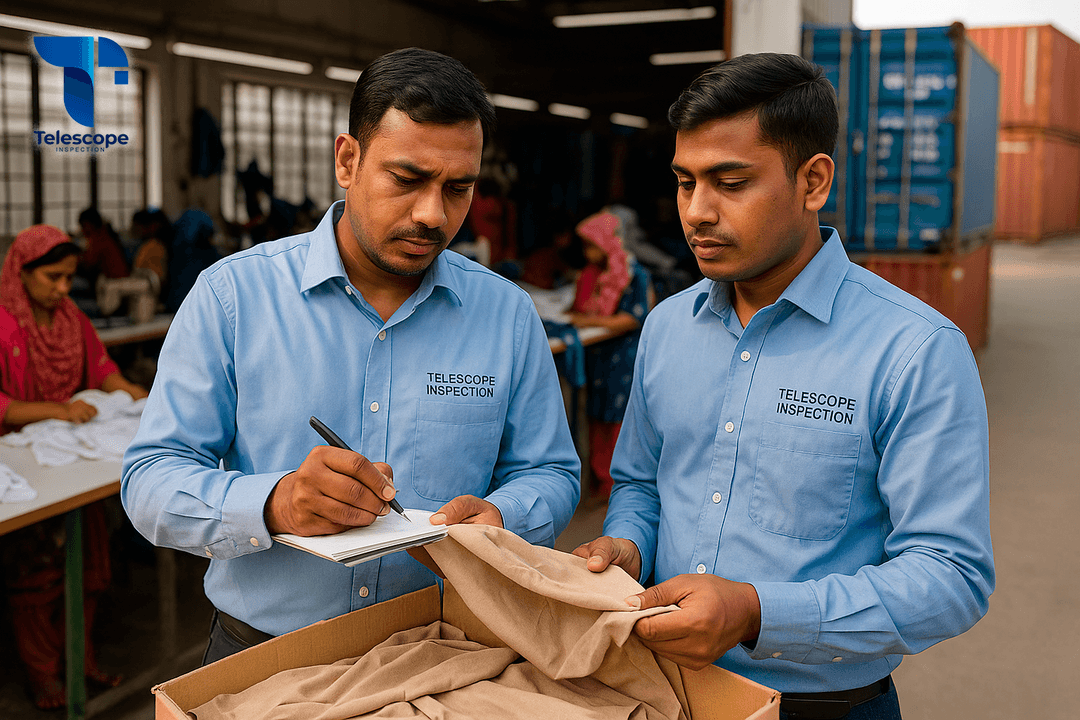
Global manufacturing relocation, combined with Telescope Inspection's positioning to navigate the new challenges of inspections at origin, ensures broad and robust geographic coverage. Growing trade and tariff tensions between the major economic powers are driving a significant shift in global supply chains. In recent years, the "tariff war" between the United States, China and other blocs has led many companies to diversify their production outside China. This industrial rethink has pushed a large share of manufacturing toward South Asia and Southeast Asia, in an effort to mitigate the risk of facing unforeseen tariffs that may be imposed in the various countries that represent the largest demand for consumer goods. As a result, strong demand has emerged for goods inspection services from new origins — that is, comprehensive verification in the country of production before shipment. In this context, Telescope Inspection offers global coverage and extensive experience in Asia, the Americas and Europe, delivering reliable and secure services — including Previo en Origen (Container Loading Inspection) — to Mexican importers and importers worldwide.
New conditions in international trade
Tariff tensions, or the global "trade war", have changed the rules of the game in world manufacturing. The imposition of high tariffs — as much as 145% in some cases — has made direct imports from certain countries far more expensive. Companies across multiple sectors have faced unpredictable duty rates that erode their margins. This creates incentives to relocate plants or suppliers to regions with favorable trade agreements or more competitive production costs. In addition, today's geopolitical uncertainty is forcing corporations to reduce risk by diversifying their supply chains (an approach known as the China+1 strategy).
Within this scenario, Asia — and particularly the countries of South and Southeast Asia — has taken center stage. Many regional governments have offered incentives for foreign investment in order to attract manufacturing. At the same time, logistics infrastructure in nations such as Vietnam, India, Indonesia and Bangladesh has improved, making it easier to move and export goods. As a result, we have seen production grow in sectors ranging from apparel to advanced electronics. This industrial reconfiguration has a visible face: the increase in shipments from new manufacturing hubs and the need for reliable inspection providers in those new origins.
• High tariffs and trade agreements: recent tariffs have prompted companies to look for suppliers in countries with a lower duty burden or with favorable trade treaties.
• Rising production costs: the gradual increase in production costs has made countries with more advantageous cost structures (India, Indonesia, Bangladesh, Vietnam) attractive destinations.
• Regional incentives: Southeast Asian governments actively promote foreign investment in manufacturing.
• Geopolitics and uncertainty: the relative stability and trade alliances of certain Asian countries give investors confidence in the face of global tensions.
In short, current world trade conditions are leading industries to relocate part of their production to South Asia and Southeast Asia. This migration of production plants means that more and more cargo is leaving those regions, which in turn multiplies the importance of inspecting goods directly at the new origins.
Relocation of manufacturing to South Asia and Southeast Asia
The shift of production toward countries such as Vietnam, Bangladesh, India and Indonesia has become massive in recent years. Traditional labor-intensive sectors, such as textiles, apparel and footwear, have moved manufacturing to Bangladesh, Vietnam, Cambodia and India, benefiting from better cost structures. Likewise, the electronics industry (components, device assembly) is expanding in Vietnam, Malaysia and India, attracting investment from major international brands. Even consumer goods and auto parts industries increasingly rely on suppliers in South and Southeast Asia.
These emerging markets offer several concrete advantages for manufacturers:
• Lower tariffs: duties on products manufactured in these countries can be lower, which helps reduce the final cost of the product.
• Tax incentives and free trade zones: countries such as Vietnam and Thailand often grant tax holidays or customs facilities to investors.
• Regional proximity: having a presence in Asia can mean access to new, growing local markets or different logistics routes (ports, railways, highways).
• Production flexibility: several Asian countries have specialized sectors (for example, Bangladesh in textiles, India in automotive), making it possible to diversify suppliers.
As a consequence, corporations from many countries have redirected their purchasing toward that region. Mexican imports from Asia, for instance, are posting considerable increases. Recent data show that in 2024 Mexico's purchases from China rose by around 10%, while those from Vietnam grew by almost 30%. Countries such as Thailand, Malaysia and Indonesia also saw sharp increases in their shipments to Mexico. This phenomenon reflects a larger flow of Asian goods into the Latin American market and, by extension, into other global markets.
This manufacturing migration is not without its challenges: different languages, variations in production standards and logistical complexity. For that reason, importing companies want assurance that whatever leaves Asia complies with the required standards and regulations. Hence a crucial need arises: to carry out inspections at the point of origin, in order to confirm before shipment that the goods fully meet all customs requirements as well as the various intellectual property and consumer protection regulations.
Growing demand for inspections at origin
When a company decides to move its suppliers to a new country, the risk of errors or non-compliance upon receipt of the goods can increase. Inspections at origin address this problem head-on. They consist of independent verification of the products at the factory or before shipment, in order to check aspects such as dimensions, quantities, packaging, labeling and legal documentation. Thanks to these inspections, importers can detect in good time any discrepancy with what was expected or with the regulations of the destination market.
In Mexico specifically, there is a service known as Previo en Origen. It consists of the verification of the cargo and its documents in the exporting country before the goods begin their journey to Mexican ports. This practice, demanded by the leading retail chains and the largest importers, seeks to speed up operations and reduce setbacks on arrival at destination. Similarly, at the international level, companies in the Americas, Europe and other regions prefer to engage inspection services at origin in order to avoid returns, penalties or other additional costs at destination.
• Risk reduction: by verifying before shipment, the likelihood of receiving defective or inconsistent lots is minimized.
• Time and cost savings: by detecting irregularities early, expenses from delays, rework or returns of goods are avoided.
• Regulatory compliance: inspections ensure that the importing country's regulations are observed (technical standards, labeling, documentation).
• Confidence for importers: having accurate information before shipping brings peace of mind, knowing that the order matches what was agreed.
In summary, the transfer of production to Asia has raised the importance of inspection services at origin. It is no longer enough to check the cargo when it arrives at the port of destination: rigorous control is required at the point of departure in order to maintain supply chain continuity. That is why the Mexican and global markets are looking for reliable partners that offer such inspection solutions, including Previo en Origen.
Key industries on the move
Manufacturing relocation is not uniform: certain sectors are moving their operations to other Asian countries with particular intensity. As these sectors increase their purchases of Asian goods, they require inspection services at origin as a priority. Among the most prominent are:
• Textiles and apparel: This sector, historically concentrated in countries with low-cost labor, has seen explosive growth in countries such as Bangladesh, Vietnam and India. Major clothing and footwear brands have relocated entire production lines. Verifying raw materials (fabrics, yarns) and finished products (garments, footwear) at origin is essential to avoid surprises in quality and compliance.
• Consumer electronics and equipment: Asia dominates the manufacture of electronic devices, circuits and components. From mobile phones to home appliances, many companies have set up factories in Vietnam, Malaysia or India. Given the complexity of these products, inspections at origin must cover functional testing, technical measurements and verification of international standards and due regulatory compliance.
• Auto parts: The automotive industry, including parts and component suppliers, has diversified its footprint beyond China. India is emerging as a growing hub for auto parts, with local suppliers and assembly plants. Verifying the accuracy of parts, the integrity of lots and safety documentation at the factories is critical to ensure the proper functioning of the global automotive chain.
• Fast-moving consumer goods: Items such as furniture and white goods, household utensils, toys and other consumer goods are also manufactured on a massive scale in Asia, and are mainly being relocated to Indonesia and Vietnam. Retail companies and global distributors import these products in large volumes. Inspecting packaging, material consistency and standards compliance (for example, electrical or child safety standards) at origin prevents setbacks on arrival at supermarkets or distribution centers.
These examples illustrate the variety of industries currently stepping up their purchasing from Asian countries. Each sector has its own particularities — both technical and regulatory — and therefore requires tailored inspection services. Experience shows that a global inspection provider must thoroughly understand each industry's specifications in order to operate effectively at origin.
Telescope Inspection: global coverage and sector experience
Against this international backdrop, Telescope Inspection has established itself as a strategic partner for major importers in Mexico and around the world. Its approach is to provide inspection services in the country of origin, with its own presence in the main manufacturing relocation regions. Thanks to its track record and operating network, Telescope is perfectly positioned to meet the growing demand for inspections at origin.
• Presence in China: From the outset, Telescope has maintained a broad and robust operation in China, with local offices and teams. This enabled it to develop a solid methodology in process control and a global client portfolio that trusts its capabilities.
• Initial expansion to other Asian countries: In 2015, the company extended its coverage to South Asia, establishing in-house teams in Bangladesh and Vietnam. These teams are made up of local professionals trained in industrial inspections, with deep knowledge of regional culture and regulations.
• Coverage in India and Cambodia since 2019: Recognizing the boom in Indian manufacturing, Telescope opened operations in India and Cambodia in 2019. In doing so, it secured direct support in one of the most dynamic emerging markets, especially for sectors such as automotive and electronics.
• Coverage in Indonesia and Malaysia since 2024: Recognizing the importance of fast-moving consumer goods manufacturing and of logistics consolidation in third countries, Telescope opened operations in Indonesia and Malaysia in 2024. In doing so, it secured coverage for the region's large furniture and textile manufacturing base and its transshipment activity.
• Comprehensive global network: In addition to Asia, Telescope Inspection has a presence in other key manufacturing regions (Europe and the Americas, for example), thus offering truly global coverage. Its Mexican clients can coordinate inspections anywhere in the world through a single point of contact.
Having its own infrastructure in each country is vital: instead of relying on outside agents, Telescope uses in-house inspectors, guaranteeing consistency of processes and confidentiality. Its teams are made up of multilingual local specialists able to coordinate inspections and reports with the timeliness and clarity that today's importers demand. As a result, the company can offer both standard inspections and advanced services (including Previo en Origen), adapting to the specific needs of each client and product.
Sectors served by Telescope Inspection
Telescope Inspection's track record has been built serving a wide range of industries, many of which coincide with those relocating manufacturing to Asia. Among the sectors in which the company has proven experience, the following stand out:
• Textiles and apparel.
• Footwear.
• Electronics and technology.
• Auto parts and automotive components.
• Fast-moving consumer goods: office and home furniture, kitchen utensils, toys and decorative items.
• Other sectors: In addition to the above, Telescope Inspection supports complementary industries that are expanding their production in Asia, such as light mobility (electric vehicles, bicycles), plastics and packaging. Its multi-sector experience allows it to adapt quickly to each client's requirements.
Each of these industries requires tailored inspection services: fast turnaround times, detailed reports and protocols adjusted to their technical specifications. Telescope's accumulated experience in these sectors ensures that inspections at origin are effective and relevant for the receiving market.
Key advantages of Telescope Inspection's offering
Given the landscape described above, Telescope Inspection offers a comprehensive solution that combines global coverage with local expertise. Its main strengths include:
• Global coverage with in-house teams: An established and robust presence in Asia (China, Bangladesh, Vietnam, Cambodia, India and Indonesia) and other manufacturing hubs, ensuring reach in the most relevant origins with no intermediaries.
• Specialization in inspections at origin: An exclusive focus on the inspection industry, with procedures designed to operate in the exporting country (pre-production, pre-shipment, factory audits, document verification).
• Multi-sector adaptability: The ability to serve multiple industries simultaneously, with an understanding of their particular production processes. This makes it possible to offer services tailored to the needs of textiles, electronics, auto parts or consumer goods, among others.
• Bilingual local teams: Expert inspectors with command of local languages and of international standards. This speeds up communication with the factories and ensures that reports are clear for international clients.
• Reliable and agile service: Standardized internal processes and technology that guarantee fast report delivery. Emphasis is placed on data reliability, allowing importers to make informed decisions well in advance.
• Focus on regulatory compliance: Experience in the customs and product regulations of different markets (including Mexico), to ensure that inspections take into account every legal and technical aspect required by importers.
Taken together, these advantages make Telescope Inspection the ideal strategic partner for companies importing from Asia and other parts of the world. They can be confident that their goods will be checked against the required standards and that any contingency will be detected before the shipment departs.
Tariff tension between economic powers and the new realities of global trade are reshaping world manufacturing. Watching industries such as textiles, electronics, automotive and consumer goods shift their production centers to South and Southeast Asian countries, the need to strengthen controls at origin becomes evident. This is where inspections at origin — including the Previo en Origen service — become vitally important, bringing security and efficiency to the international supply chain.
Telescope Inspection, with its solid presence in China, Bangladesh, Vietnam, Cambodia, India and Indonesia, is positioned as a key player in this process. By combining a global network with deep local knowledge and sector experience, the company is perfectly prepared to meet the growing demand for inspections from new origins, in step with the China+1 strategy. It thus gives Mexican and global importers the confidence that their goods will comply with what was agreed before being shipped, helping to make manufacturing relocation an orderly, agile and successful process for all parties involved.
Telescope Inspection will continue to expand its presence and capabilities, committed to supporting its clients at every step of the global supply chain.