
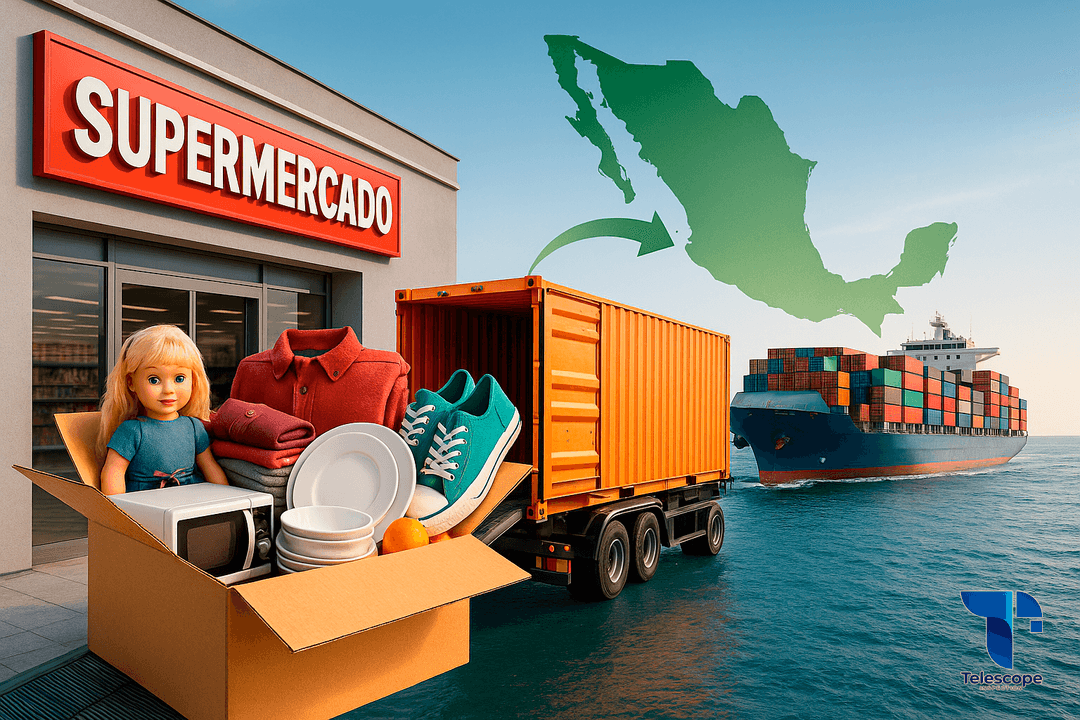
Previo en Origen (PEO) — Telescope's inspection at origin before shipment, applying Mexican customs criteria.
Importing from China to Mexico requires five things before the first shipment: being registered in the SAT's Importer Registry, having a valid e.firma, classifying the product under the correct TIGIE tariff code, hiring a customs broker and preparing the full file (commercial invoice, packing list, transport document, COVE and entry declaration). The typical sea route takes 25 to 40 days depending on the port, and the import cost adds the duty, the 0.8% DTA and the 16% VAT. What almost nobody plans for is what happens before shipment. And one prior step decides the whole operation: Telescope Inspection's Previo en Origen, which verifies the cargo at the factory before it ships.
Table of contents
- Can anyone import from China to Mexico?
- What is the real first step before buying from a Chinese factory?
- How do I find the tariff code for my product?
- What documents do I need to import from China to Mexico?
- How much does it cost to import a container from China?
- How long does the whole process take, from factory to warehouse?
- Which sea routes and ports are used from China?
- What happens when the product reaches a Mexican port?
- What are the five most expensive mistakes when importing from China?
- What changed with the 2026 Customs Law reform?
- The step almost nobody plans for: verifying before shipment
- Frequently asked questions
- How Previo en Origen fits in
Can anyone import from China to Mexico?
No. Importing in Mexico is a regulated activity and requires being registered as an importer with the SAT and meeting current tax obligations. Individuals with business activity and legal entities can do it, but it is not an automatic procedure: the SAT can suspend registration and the customs authority can reject the clearance.
The basic requirements, according to the SAT itself, are:
- Being registered and active in the RFC.
- Having a valid e.firma.
- Being up to date on tax obligations.
- Having an active, locatable tax domicile.
On top of that comes registration in the registry corresponding to your sector. If your product falls into a specific sector category (textiles, footwear, chemicals, steel, among others), the sector registry is additional and mandatory.
A fact that surprises many first-timers: registration in the Importer Registry does not automatically authorize you for all products. Authorization is by sector and by activity.
What is the real first step before buying from a Chinese factory?
The real first step is not getting a quote from the supplier. It is defining your product with the precision Mexican customs demands: what it is, what it is made of, what it is for, and which tariff code it falls under. That code determines:
- the duty you will pay,
- whether it requires a prior permit,
- whether an Official Mexican Standard (NOM) applies,
- whether it requires a health certificate or one from another authority,
- and whether non-tariff regulation exists in general.
Importing without resolving this first is the most frequent cause of delays and cost overruns: you find out about the problem when the container is already at the port and every day counts.
Logical order of a first import
| Stage | What to do | Before |
|---|---|---|
| 1 | Define product and commercial use | Quoting |
| 2 | Classify in the TIGIE (8 digits + NICO) | Buying |
| 3 | Review non-tariff regulations (NOM, permits) | Signing the purchase order |
| 4 | Register in the Importer Registry (+ sector if applicable) | Shipment |
| 5 | Hire a customs broker | Shipment |
| 6 | Define Incoterm and logistics responsibilities | Quoting freight |
| 7 | Verify the merchandise at the factory before shipment | Closing the container |
| 8 | Shipment, transit, clearance | — |
Step 7 is the most often skipped and the most expensive. We detail it below.
How do I find the tariff code for my product?
The tariff code is obtained by classifying the product within the TIGIE (Tariff of the General Import and Export Duties Law). In Mexico classification is expressed with 8 digits; with the NICO (Commercial Identification Number) of 2 additional digits it reaches 10.
Free official tools:
- INEGI — TIGIE:
inegi.org.mx/app/tigie/ - SNICE — LIGIE:
snice.gob.mx - One-Stop Shop classifier:
ventanillaunica.gob.mx/vucem/Clasificador.html - SIICEX-CAAAREM:
siicex-caaarem.org.mx
The TIGIE is structured in five levels, from general to specific:
- Section
- Chapter
- Heading
- Subheading
- Tariff code (and NICO)
The golden rule of classification
Classification is by commercial use, not by composition or the nature of the material. The same article may look like "plastic" (chapter 39) and yet be classified under another heading because its commercial function is different.
Practical example: a decorative plastic lamp is not classified with plastics. It is classified with lamps, because its commercial use is to illuminate. Customs classifies by function.
If your product has more than one possible function, your customs broker's opinion carries weight. Consulting beforehand saves you a later reclassification.
What documents do I need to import from China to Mexico?
The minimum file for a commercial import is this:
| Document | Who issues it | What it is for |
|---|---|---|
| Commercial Invoice | Chinese supplier | Basis of the customs value |
| Packing List | Chinese supplier | Detail of packages, weights and contents |
| Transport document (sea B/L, air waybill AWB, land bill) | Shipping line / airline / carrier | Traceability of the merchandise |
| COVE (Electronic Value Certificate) | Customs broker | Electronic declaration of value |
| Import entry declaration | Customs broker | Formal declaration to customs |
| Prior permits / certificates / NOM | Authorities or accredited labs | Depending on the tariff code and applicable regulation |
| Certificate of origin (if applicable) | Chamber or authority of the country of origin | Rules of origin / tariff preferences |
What almost nobody checks on the commercial invoice
The commercial invoice is not "the paper that says how much you paid." It is the basis of the customs value and therefore of the duty and VAT. An invoice with generic descriptions ("metal parts", "plastic goods", "accessories") is a direct risk: it makes classification harder and increases the chance the authority flags the operation at the port.
Concrete operational recommendation:
- Ask the supplier for specific descriptions in Spanish or bilingual.
- Verify that quantity, unit price and total match the packing list.
- Verify that weight and number of packages match the B/L.
- Do not accept an "invoice" with a declared value different from what was paid.
Any inconsistency between invoice, packing list and B/L becomes an observation at customs. And an observation means delay.
How much does it cost to import a container from China?
The cost has three distinct blocks that must not be confused: merchandise cost, logistics cost (freight, insurance, handling, storage) and tax cost (duty, DTA, VAT).
Tax block — verifiable legal rates
| Concept | Rate | Base |
|---|---|---|
| DTA (Customs Processing Duty) | 0.8% | Customs value |
| IGI (General Import Duty) | Varies by tariff code | Customs value (depends on treaties) |
| VAT | 16% | Customs value + IGI + DTA |
The 16% VAT is calculated on the sum of the customs value, the duty and the DTA itself. It is not calculated only on the value of the merchandise: that is a very common calculation error.
According to logistics operators, for most Chinese products the IGI falls in a 2% to 5% range, though it depends entirely on the tariff code.
Logistics block — market ranges
Ocean freight ranges are set by the market and change week to week. With data published by logistics operators for 2026:
| Concept | Market range (US$) |
|---|---|
| Ocean freight 40' standard / High Cube, China → Manzanillo or Lázaro Cárdenas | 2,500 – 5,500 |
| Ocean freight 20' China → Mexico | 4,200 – 5,400 |
| Ocean freight 40' China → Mexico | 6,600 – 8,100 |
The ranges above are operator references, not official rates. Freight in high season (before Chinese New Year, for example) can be at the upper end; in low season, at the lower end.
Customs broker fees
According to industry operators, customs broker fees range between $3,000 and $15,000 MXN per operation, depending on the complexity of the entry, the tariff code and the number of line items.
Illustrative tax calculation example
This is an arithmetic example, not a quote. It serves to understand how the concepts stack.
| Concept | Calculation | Result |
|---|---|---|
| Customs value (merchandise + freight + insurance) | — | $1,000,000 MXN |
| IGI (assume 5%) | 1,000,000 × 0.05 | $50,000 MXN |
| DTA (0.8%) | 1,000,000 × 0.008 | $8,000 MXN |
| Subtotal before VAT | 1,000,000 + 50,000 + 8,000 | $1,058,000 MXN |
| VAT (16%) | 1,058,000 × 0.16 | $169,280 MXN |
| Total payable at customs | 50,000 + 8,000 + 169,280 | $227,280 MXN |
Roughly 22.7% additional over the value of the merchandise. To budget, most importers use a multiple between 1.25 and 1.35 of the merchandise value at the factory, depending on the duty and the freight.
How long does the whole process take, from factory to warehouse?
Timing varies widely by supplier, port and season. What is stable is the structure of the process:
| Stage | Typical duration |
|---|---|
| Production at the factory | Variable (depends on the order) |
| Transfer factory → Chinese port | 1–5 days |
| Consolidation and container closing | 1–3 days |
| Ocean transit China → Mexico | 25–40 days depending on route and port |
| Unloading, storage and clearance at the port | Variable |
| Transfer port → destination warehouse | 1–5 days depending on location |
The most underestimated stage is unloading and clearance. That is where documentary or classification problems surface that could have been avoided before shipment.
Do not promise delivery dates to your customers without adding a buffer. Mexican customs operates with random examination: any container can be selected for examination and that adds time, regardless of how well prepared your file is.
Which sea routes and ports are used from China?
Mexico receives Chinese containerized cargo mainly through the Pacific. The most used destination ports are:
- Manzanillo — the port with the highest cargo volume in Mexico. It is the gateway of choice for Asia.
- Lázaro Cárdenas — handled 27.3 million tonnes at the close of 2025 and 17.4 million tonnes at the close of July 2026, according to the port's own official figures. Especially relevant for the center of the country.
- Veracruz — for Gulf destinations and the transoceanic route via the Suez Canal.
On the Chinese side, the most frequent departure ports are Shanghai, Ningbo, Qingdao, Tianjin, Xiamen, Yantian and Shekou. The choice of departure port depends on where the factory is: moving a container 1,000 km inside China can cost more than the difference between one destination port and another.
And the land route from China?
There is no land border between China and Mexico. All commercial China-Mexico cargo arrives by sea or air. Some importers try multimodal routes through Central Asia or other geographies, but for commercial volume the sea route is the norm.
What happens when the product reaches a Mexican port?
When the container reaches the Mexican port, four things happen in sequence:
- Unloading and storage at the port facility.
- Payment of the DTA and the entry declaration (or its declaration, depending on the regime).
- Automated selection mechanism: customs decides whether the container goes through customs examination or not. This mechanism is random.
- Release and transfer to your warehouse.
If everything is well prepared, the flow is smooth. If there are documentary or value inconsistencies, the container enters an observation stage that may require:
- reconfirmation of data at the port,
- presentation of supplementary documentation,
- or, in the worst case, redoing the inspection at the port.
That last scenario is the expensive one. In it, the authority performs a physical verification of the merchandise at the port facility, while the container remains there generating storage costs and customers waiting.
What are the five most expensive mistakes when importing from China?
1. Misclassifying the tariff code
Duty paid too low and, later, a tax credit or a fine. Nothing is more expensive and nothing is easier to avoid.
2. Not verifying the merchandise before shipment
If the merchandise shipped does not match what was declared on the invoice and packing list, the problem is discovered at the port. And at the port there is nothing left to correct: there is only delay to pay for.
3. Using invoices with generic descriptions
"Plastic products" on an invoice is an invitation to an observation.
4. Not reviewing non-tariff regulations
Labeling NOMs, health certificates or prior permits are not resolved at the port. If the product arrived without the labeling NOM that applies to it, customs can go as far as a precautionary embargo. Resolving it at origin is infinitely cheaper than resolving it at the port.
5. Not having an evidence file from the day of loading
This is the invisible mistake. When customs examines the merchandise, the question is not only "is this what the invoice says?". The question is also: "in what condition did it leave the factory, with what weight, with what equipment, when, and who closed it?". If you do not have that proof, you have no defense. You only have your word.
What changed with the 2026 Customs Law reform?
The reform entered into force on January 1, 2026, with transitional provisions. The changes that most affect the importer are:
- New minimum documentation is established for the electronic customs file.
- It is required to attach the documents that demonstrate compliance with rules of origin when merchandise comes from countries with trade agreements with Mexico.
- The liability exemptions that existed for customs brokers under the previous law are repealed.
- A 20-year term, extendable, is established for the customs broker's license.
- Levels of traceability and documentary control are raised.
The underlying message: the documentary file matters more than ever. The reform pushes the importer to demonstrate, not just declare. And when the authority asks you to demonstrate, evidence of what happened at origin — photos, date, condition of the merchandise, of the container, loading conditions — becomes part of the defense.
The step almost nobody plans for: verifying before shipment
Of all the steps above, the only one that can be done while the merchandise is still in China is verifying at the factory, before the container leaves. Everything else — registry, tariff code, documents, entry declaration — can be corrected up to the last day. The physical merchandise cannot.
That is where Telescope Inspection's Previo en Origen comes in: the cargo is reviewed at the Chinese factory or warehouse, against the invoice and packing list, with the criteria Mexican customs will apply on arrival. The condition of the merchandise, the container, the date, the photos and the weather on the day of loading are documented.
The practical difference: if the product shipped does not match what was declared, with Previo en Origen the error is detected in Shanghai or Ningbo and corrected before shipment. Without it, it is discovered in Manzanillo, when all that is left is paying for the delay.
Telescope Inspection has done this since 2009, with more than 300,000 containers inspected in 20 years and a record of 0% of incidents that required redoing the inspection at the port.
Frequently asked questions
Do I need a company to import from China to Mexico?
Not necessarily. An individual with business activity can import if registered in the RFC, with a valid e.firma, up to date and with an active tax domicile. Many importers start this way and migrate to a legal entity as volume grows.
Can I import without a customs broker?
Customs clearance requires a broker except for specific exceptions provided by law (for example, imports by international passengers and certain special cases). For regular commercial import, you do need a broker. See the full guide at importing without a customs broker.
How long does a shipment from China to Mexico take by sea?
Between 25 and 40 days of ocean transit, plus clearance and transfer time, depending on the port and route. In high season (before Chinese New Year) space booking and transit times usually lengthen.
What happens if my product needs a NOM?
If your tariff code is subject to a labeling NOM (such as NOM-050-SCFI-2004), you must comply before clearance. The exact obligation depends on the product and the tariff code. See the guide on NOM for importing to Mexico for details.
Can I import samples or low-value merchandise without the whole procedure?
There are simplified regimes and particular treatments for samples and for courier shipments. The courier and parcel rules in force since January 1, 2025 establish payment of the global IGI rate (17%) on imports over US$50. If your case is a commercial sample or a parcel shipment, it is worth reviewing the minimis regime.
How do I verify that the Chinese supplier is reliable?
Three basic filters: (1) verification of the entity in China (that the company legally exists and has a track record), (2) a factory audit prior to production, and (3) an inspection before shipment. The third is the only one that confirms that what is being loaded is what is being paid for.
How long from paying for the merchandise to receiving it at my warehouse?
It depends on the Incoterm. Under FOB, from delivery to the carrier at the Chinese port to your warehouse: 30-50 days, depending on port and regime. Under EXW, add the inland transfer in China. Under DDP, your supplier assumes everything, but almost never really does so without raising the price.
How Previo en Origen fits in
An import plan from China to Mexico has two halves. The first is documentary and logistical: registry, tariff code, invoice, transport, entry declaration. The second is evidentiary: proving what left the factory, when and in what condition. You can see the full service at /servicios/previoenorigen.
Previo en Origen is the inspection performed at the supplier's factory or warehouse, before shipment, with the criteria Mexican customs will apply on arrival. It is not a process audit or a product conformity assessment: it is the verification of the merchandise and the loading circumstances, executed where something can still be done.
Telescope Inspection is a pioneer of Previo en Origen in Mexico and has applied it since 2009, with more than 300,000 containers inspected in 20 years and a statistical record of 0% of incidents that required redoing the inspection at the port. Coverage is global, with its own inspectors — not subcontractors — in more than 85 countries, and coverage for any other origin.
The operational result is a defense file built on the day of loading: merchandise condition, container condition, date, photos, weather, and documentary compliance. The day it is loaded is the only moment that evidence can be captured. After that, it is history.
Learn about the service at /servicios/previoenorigen. If your first shipment is in preparation, the best investment is to verify before, not after.
Sources
- SAT — Importer Registry for Specific Sectors (registration): https://www.sat.gob.mx/minisitio/PadronImportadoresExportadores/pi_inscripcion.html
- SAT — Importer Registry: https://www.sat.gob.mx/minisitio/PadronImportadoresExportadores/index.html
- INEGI — TIGIE (tariff code lookup): https://www.inegi.org.mx/app/tigie/
- SNICE — LIGIE: https://www.snice.gob.mx/cs/avi/snice/ligie.info22.html
- One-Stop Shop — Tariff classifier: https://www.ventanillaunica.gob.mx/vucem/Clasificador.html
- SIICEX-CAAAREM: http://www.siicex-caaarem.org.mx/
- KPMG Mexico — Customs Law Reforms: https://kpmg.com/mx/es/tendencias/2025/11/flash-reformas-a-la-ley-aduanera.html
- EY Mexico — Customs Law Reforms for 2026: https://www.ey.com/es_mx/technical/tax/boletines-fiscales/reformas-ley-aduanera-para-2026
- Puerto Lázaro Cárdenas — official figures: https://www.puertolazarocardenas.com.mx/noticia/293