
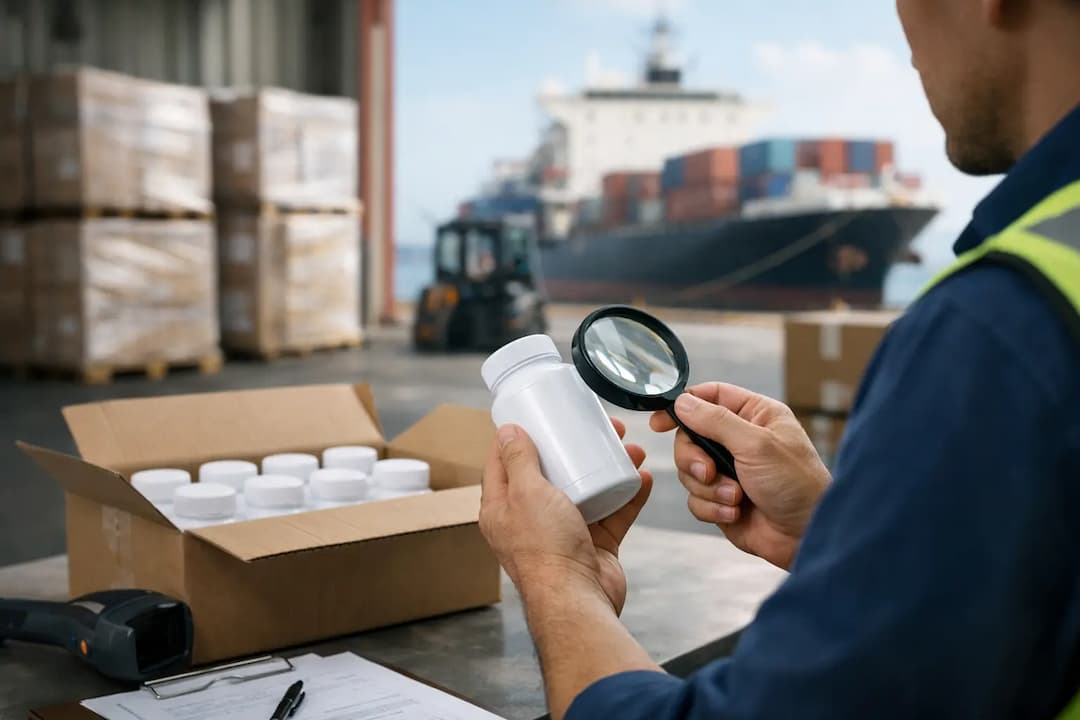
A shipment can be commercially correct and still fail at the label. The product may match the purchase order, the packing list may be complete, and the container may be sealed properly, yet one wrong UPC, one missing country-of-origin marking, or one inconsistent carton label can create avoidable cost after departure. That is why labeling inspection before export matters. It gives importers, brokers, and logistics teams a documented check on one of the most exposed parts of shipment readiness.
Labels carry operational truth. They connect the physical product to the commercial invoice, the packing list, the master carton, the barcode system, the customs entry, and often the retailer's receiving process. When those points do not align, the result is usually not a minor correction. It can mean a customs hold, a warehouse exception, a retailer chargeback, relabeling labor, shipment segregation, or a dispute with the supplier over what was actually packed.
What labeling inspection before export actually verifies
A proper labeling inspection before export is not a quick visual glance at one carton. It is a structured review of whether product labels, inner packaging labels, and carton marks match the transaction and shipment records. The goal is to confirm that what will leave origin can be identified, traced, and processed correctly when it arrives.
At the product level, inspection typically checks item identifiers such as SKU, model number, UPC or barcode data, product description, size or variant, and any legally required origin marking. Depending on the product category, it may also include care labels, warnings, composition details, batch or lot data, expiration dates, or language requirements. At the carton level, the review often extends to shipping marks, carton count logic, PO references, destination labels, and any retailer-specific format requirements.
This matters because labeling errors rarely stay contained. A mismatch between the unit label and outer carton can trigger receiving exceptions. A mismatch between the label and invoice can complicate customs review. A mismatch between the barcode and the buyer's item master can create downstream inventory problems that take days to sort out.
Why labeling errors create outsized risk
Labeling seems simple until a shipment is moving across functions. Procurement expects the ordered item. Compliance expects required declarations and markings. Customs brokers expect consistency with entry data. Distribution teams expect scannable, correct identifiers. Retail customers expect floor-ready goods. A label sits at the center of all of that.
The risk is not only regulatory. It is operational and financial. If the wrong product label is applied to the correct product, the goods may still be physically usable, but they are no longer easy to clear, receive, or sell. If the correct product is loaded into cartons marked with the wrong destination or PO, the issue can spread through deconsolidation, cross-dock handling, or retailer appointment scheduling.
There is also a timing issue. Most labeling failures are cheapest to correct before container loading. Once cargo has departed, the same issue often becomes a chain of workarounds involving customs communication, destination relabeling, rework labor, storage, and claim management. The earlier the discrepancy is documented, the more options the importer has.
The most common findings in a labeling inspection before export
In practice, recurring labeling issues are rarely dramatic. They are usually small mismatches with large consequences. Incorrect UPC assignment is one of the most common. So is an item description on the carton that does not match the commercial documents. Country-of-origin marking is another frequent weak point, especially when production shifts between facilities or when mixed packaging inventories are used.
Another common problem is inconsistency between approved artwork and live production output. A supplier may show the right label file during pre-production, then run packaging from older stock during final packing. Retail routing labels can also be wrong even when the product labels are correct. That creates a different risk profile - less about customs and more about receiving delays, noncompliance fees, or routing confusion.
Not every issue has the same weight. A typo in a noncritical field may be acceptable depending on the buyer's standards and the product class. A missing origin marking or a wrong barcode is not in the same category. A disciplined inspection process separates cosmetic variance from shipment-critical failure.
What good evidence looks like at origin
Inspection has more value when it produces usable records, not just a pass or fail statement. For labeling verification, good evidence includes timestamped photos of product labels, inner packs, master cartons, barcode areas, and side-by-side comparisons against shipping documents or buyer specifications. It should also capture quantity context - how many units or cartons were observed, where they were located, and whether the issue appears isolated or systemic.
That evidence matters for decision-making. If a discrepancy is limited to one batch, the importer may choose to hold only that portion. If the issue affects all visible cartons in packed inventory, the response will likely be broader. A documented inspection record also gives customs brokers and internal compliance teams something concrete to review before filing, routing, or escalating.
This is where an origin-based inspection model becomes more useful than a simple supplier confirmation. Supplier statements can help, but they are not independent verification. An evidence-based inspection record creates a clearer basis for action because it ties the finding to observed product identity, packaging condition, and shipment context before export.
Who should rely on pre-export label checks
Importers with private-label programs are obvious candidates, but they are not the only ones. Any business managing multiple SKUs, retailer compliance standards, or customs-sensitive categories benefits from label verification before departure. That includes distributors, multi-vendor import programs, ecommerce brands scaling overseas production, and logistics providers asked to coordinate around incomplete supplier data.
For customs brokers, early label visibility can reduce avoidable surprises at entry. For freight forwarders and 3PLs, it can prevent downstream handling problems tied to misidentified cargo. For procurement and quality teams, it adds a factual checkpoint between supplier assurances and shipped reality. The value is cross-functional because labels affect more than product appearance.
When a labeling inspection should happen
Timing depends on the shipment profile, but late-stage inspection is not always enough. If labels are applied during production, an in-process check may catch template or artwork drift before full packing is complete. If labels are applied during final packing, the critical inspection point may be just before loading. High-risk programs sometimes need both - an earlier verification to confirm label setup and a final check to confirm packed goods match the approved standard.
The right timing also depends on correction options. If the supplier can relabel quickly at origin, inspection before container stuffing gives the buyer a practical recovery path. If correction resources are limited, earlier visibility becomes even more valuable. It is not just about finding errors. It is about finding them while there is still room to act.
How to make labeling inspection more useful internally
The strongest inspection programs do not treat labels as an isolated quality item. They connect labeling findings to the documents, loading event, and shipment identity. That means the inspection output should be shareable across purchasing, compliance, brokerage, and logistics functions without forcing each team to reconstruct what happened.
A structured digital record is especially useful here. When photos, observed discrepancies, carton references, and shipment details are organized in one evidence set, teams can make faster decisions on release, correction, escalation, or claim preservation. Previo en Origen® approaches this through documented origin inspections tied to shipment evidence, so the finding is not just that something was wrong, but what was seen, where it was seen, and before which shipment event.
That level of traceability changes the conversation with suppliers as well. General complaints lead to debate. Specific evidence tied to product and carton identity leads to resolution.
Labeling control before export is not about perfection for its own sake. It is about keeping one preventable error from turning into a customs issue, a receiving failure, or a dispute with no proof. Before cargo leaves origin, labels are still correctable. After departure, they become consequences. A disciplined inspection at that stage gives your team something more valuable than reassurance - it gives you defensible facts when timing still matters.