
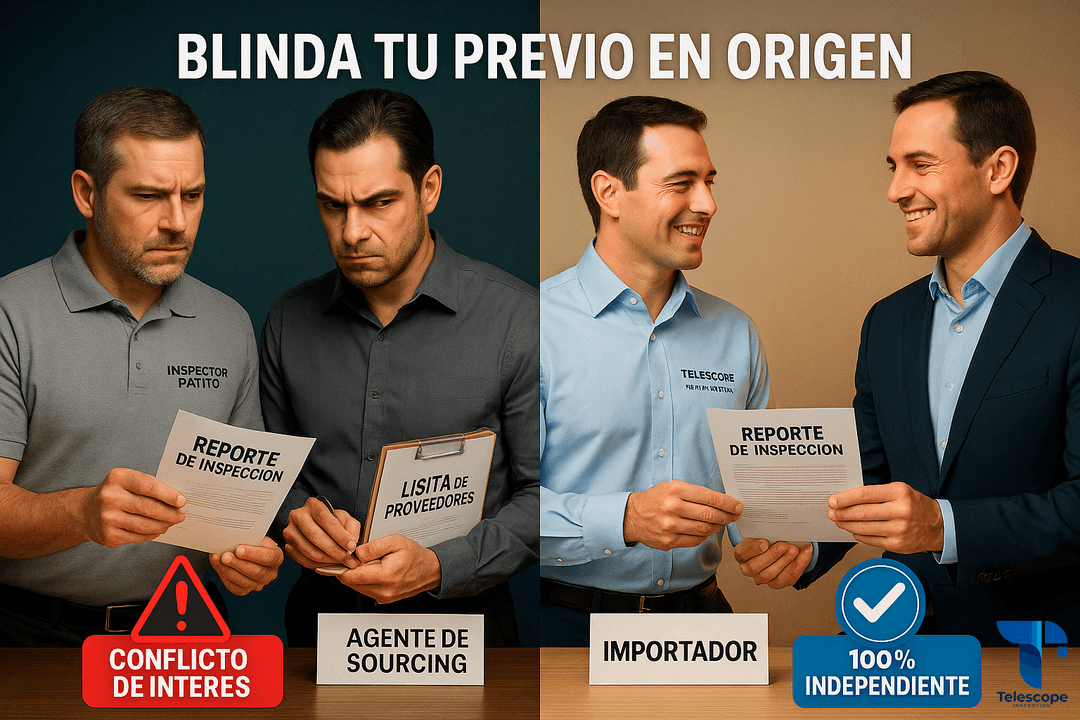
Risks of mixing sourcing and origin inspection
In the context of international trade and the modern supply chain, Mexico's large retail chains rely on suppliers in Asia and other markets to stock their merchandise. To verify regulatory compliance, many of them contract Previo en Origen (Container Loading Inspection) services, that is, inspection performed before the goods are shipped. However, choosing a provider that also offers sourcing (supplier search and management) can create serious strategic risks. When one and the same company carries out inspections while also identifying new suppliers, a strategic dependency arises: the inspection company may absorb those factories into its own supply network and use them to favour other clients, or even to compete indirectly with the original retailer. This jeopardises the buyer's information confidentiality and its competitive advantage. As industry experts explain, when an inspection provider also does sourcing "there is an inherent conflict of interest" that may lead the provider to cover up failures and compromise the integrity of the inspection. In addition, the dual-role company may leak sensitive information —such as product designs, technical data sheets, supply chains or logistics structures— to third parties. Telescope Inspection warns that "when companies work with inspection providers, they often share sensitive information such as product designs, specifications and supply chain details. If the inspection provider is also engaged in sourcing, there is a risk that this information may be used inappropriately or shared with other clients." In short, this dual-function model can result in strategic information leakage, loss of trade secrets and a weaker position for the retailer against its competitors.
Beyond the classic conflict of interest, these risks involve the improper use of confidential and operational data. It is not only a matter of biased compliance reports, but of unauthorised access to internal logistics, inventory levels, shipping routes, regulatory compliance records and other critical documentation. Any deviation from what was agreed, or the appearance of new suppliers discovered during an inspection, could benefit other clients of the service provider. Parallel supplier networks may even emerge, in which the former client becomes a competitor. The dangers therefore go beyond a simple technical conflict of interest and fall squarely within the field of information security and strategic competitiveness. In this scenario, preserving the confidentiality of project specifications, technical data sheets and logistics structures is vital for the retailer; any leak may mean theft of intellectual property, disclosure of commercial tactics, or exposure of prices and margins.
Independence and experience: how Telescope Inspection mitigates the risk
To address these risks comprehensively, an independent, specialised inspection partner is essential. Telescope Inspection positions itself as precisely that trusted ally. First, Telescope is dedicated exclusively to cargo inspections (Container Loading Inspection) and does not carry out sourcing activities or represent manufacturers. This unique specialisation guarantees that its reports are completely objective. As the company itself states: "Telescope Inspection is dedicated exclusively to providing professional inspection services. We do not engage in sourcing activities or supplier search, ensuring that our focus remains on delivering accurate and impartial inspection results." Thanks to this exclusive model, the retailer can be certain that there is no hidden conflict of interest.
Telescope also brings more than 15 years of experience in first mile inspections. It began operations in Mexico in 2006 and was a pioneer among Latin American companies in establishing itself in China in 2008. Since then it has expanded its coverage to Asia, Latin America and Europe. This long track record is reflected in a solid, contingency-free history (with a verifiable record of 0% incidence) and in certified standards (it holds, among other certifications, ISO 9001:2015, ISO 37001-2016 and Achilles Network membership). Its extensive experience and its status as a pioneer in the Latin American inspection market ensure mature, proven processes. As its corporate values state, one of its priorities is Information Security, with "zero tolerance for corruption" and management systems that give the client certainty.
Telescope also offers international coverage tailored to global chains. It operates in Mexico, China, Bangladesh, Cambodia, South Korea, Guatemala, India, Indonesia, Panama, Thailand, Vietnam and Europe. This ensures that it can inspect at origin in practically any key factory, coordinating dates, logistics and reports without depending on local third parties. For a procurement executive it is essential to verify that the Previo en Origen provider has presence in the countries and regions of interest, and Telescope meets this condition.
Finally, Telescope incorporates advanced technological tools that increase transparency and information security. For example, its digital platform Efficax is a first mile information management system based on blockchain. This means that every inspection record is cryptographically locked and remains immutable: "The Efficax System is an information management tool developed with Blockchain technology that makes it possible to preserve the integrity and security of the information gathered by Telescope during our inspection. This information is always available and visible to users from any device connected to the internet." As a result, the data generated during the Previo en Origen is traceable and verified, adding an extra layer of trust. The use of blockchain guarantees that no one can alter the integrity of the inspection reports, which reinforces documentary security and facilitates subsequent audits. All in all, Telescope's specialisation, independence, global coverage and technological innovation completely eliminate the risks associated with strategic dependency and conflicts of interest.
Operational benefits of an independent Previo en Origen
Contracting a Previo en Origen with a genuinely independent provider such as Telescope Inspection has very tangible operational impacts for the retailer:
• Drastic reduction in customs times. With compliance guaranteed from origin, the cargo is usually released from customs within 24–48 hours of arrival. Telescope reports that its service reduces average clearance from 5–8 days to less than 48 hours. This speeds up the entry of merchandise into the country and avoids the unforeseen delays that typically occur when inspection is left until destination. Previo en Origen inspections accelerate customs clearance; shipments are generally released from customs within 24–48 hours. For executives, this means lower logistics costs and greater certainty when planning inventory and distribution.
• Lower legal risk and assured compliance. By verifying regulatory and customs conformity before shipment, the Previo en Origen virtually eliminates the risk of penalties, seizures or fines in Mexico. With all labels, standards (NOM) and permits correct from origin, there are no longer late errors that trigger costly rework (re-labelling, corrections to the customs declaration (pedimento), returns, and so on). Moreover, on completion of a Previo en Origen the client receives a report with operational validity before the customs authority, equivalent to official documentary backing. This gives the importer legal peace of mind: any subsequent inspection or audit will find that the product had already undergone a rigorous legal check.
• Full visibility of the first mile. Inspecting before shipment provides control and transparency from the very start of the chain. Inspection reports include photographic records, accurate counts and evidence of packaging and labelling. By relying on digital platforms (e.g. blockchain and a control tower) the importer has access at all times to the status of the shipment. As Telescope points out, this amounts to a "documented chain of custody for the merchandise from origin to destination", where any authorised party (importer, customs broker or authority) can consult the container's history. This level of traceability facilitates logistics coordination, improves the prediction of clearance times (turning this factor into no more than a constant variable) and makes it possible to plan transport and warehousing in advance.
• Documentary confidence in audits. By carrying out the Previo en Origen, the client obtains a regulatory compliance report with customs scope, full of evidence and verification. This translates into irrefutable documentation during internal or external inspections. For example, Telescope highlights that it uses blockchain so that "the information is immutable and even more reliable in terms of data integrity". Thus, in internal audits or regulatory controls, the retailer can present a solid report proving compliance from the moment the goods left the factory, which reduces the risk of objections and strengthens product accountability and traceability. And should a discrepancy nevertheless be detected, it will be reported in good time so that the corresponding corrective measures can be implemented at the port of destination.
Taken together, these operational benefits improve supply chain efficiency and competitiveness. Various experts agree that an independent Previo en Origen saves time and money: inspection helps identify problems and resolve them in advance, thereby reducing the time required and the additional costs incurred. In short, an independent provider brings certainty, agility and security to the import process, reinforcing the retailer's ability to deliver on its promises of regulatory compliance and on-time supply to customers.
Recommendations for choosing a Previo en Origen provider
For procurement, logistics and supply chain executives at large retail chains, it is crucial to assess clear criteria when contracting a Previo en Origen service. Among them, we highlight the following:
• Independence and exclusive focus: Make sure the provider does not carry out sourcing activities or represent manufacturers. Its role must be limited to inspecting and certifying product, free of conflicts. As Telescope states, "we are dedicated exclusively to inspection services… We do not engage in sourcing or supplier search." Separating roles protects the objectivity of the report.
• Proven experience: Check the provider's track record in the specific Previo en Origen service. Favour companies with broad international experience and demonstrated success stories. Telescope, for instance, has been a pioneer in Mexico and Asia since 2006. A long history free of compliance incidents indicates mature, well-controlled processes. Ask for references and concrete results to validate performance.
• Geographic coverage and operational capacity: The provider must have presence or a global network covering the regions where your suppliers are located. Assess its logistics capability (qualified local teams, scheduling and shipment coordination) to carry out timely inspections. Telescope, with operations in Asia, Latin America and Europe, guarantees coverage in line with international chains, avoiding the use of unreliable subcontractors that only drive costs up.
• Supporting technological tools: Value the use of advanced digital platforms that facilitate traceability and report generation. Look for features such as online portals, multimedia reports and, preferably, blockchain solutions that ensure data immutability. Telescope, for example, has the blockchain-based Efficax System, which adds an extra level of assurance regarding information integrity. These tools improve real-time communication and documentary confidence.
• Certifications and quality standards: Make sure the provider holds international certifications (such as membership of global supply chain networks like Achilles Network) and follows clear inspection standards. This includes rigorous protocols for quality control, information security and anti-bribery. Telescope, with ISO certifications and "zero tolerance" policies towards corruption, is an example of a company structured around these aspects. A formal, certified provider demonstrates a commitment to excellence.
• Transparency in reporting and communication: Inspection reports must be detailed, objective and accessible. Confirm that the provider delivers visual evidence (photos, videos) and accurate data. Also assess how easy it is to access project information. A clear system for delivering results —online platforms or downloadable files, for example— facilitates internal audit and decision-making. Telescope emphasises the delivery of "objective and transparent" reports with no alterations, which should be a requirement for any reliable provider.
Ultimately, the ideal Previo en Origen provider is objective, experienced and technologically capable. It must be an ally that protects the retailer's interests, not a party that can profit from its strategic information. By following these criteria —independence, experience, global reach, technology and transparency— executives will be able to maximise the security and efficiency of their imports from origin, reducing risks and guaranteeing the conformity of their merchandise.